With the volume of complex financial transactions being processed daily by businesses today, maintaining trust in a commercial environment relies on transparency and full compliance with all regulations—hard truths. One of the important ways in which organizations hold themselves accountable is through audit exemption. Audits offer a third-party opinion about its financial statement to ensure it is accurate and fair as per legal mandate. It’s way too much of a headache, but not every company has to do this.
There may not be a requirement to audit in a private company. Many jurisdictions around the world have set criteria for audit exemption, allowing smaller companies to avoid the full burden of an audit. Determining whether your private company is exempted from audit or falls under the compulsion to be audited, would critically impact operational planning and cost management.
In this blog, we are going to discuss the criteria necessary for audit requirements and exemptions of private companies along with legal & financial consequences associated with each.
Audit Requirement: Why Do Audits Matter for Private Companies?
However because they are private companies, with no mandatory reporting requirements, many authorities require them to undergo audits under certain conditions. These conditions generally pertain to the size, organization, or type of business operations a company is trying to engage in.
Audits serve several significant purposes for private companies:
- Credibility and Trust: Having an auditable set of financial statements increases the confidence of potential investors, partners, or even lenders. This means that any request for external financing or partnerships will have the backing of an objective verification of the company’s financial health.
- Compliance with Regulations: This being said, a significant number of countries oblige entirely (or partially) to abide by certain financial reporting regulations that companies have. An audit ensures that these financial documents adhere to the standards set forth by them. This keeps penalties and legal complications far from the company’s doors reached into its corners.
- Internal control: You can use audits as a kind of health check to ensure that company operations are running by standard accounting practices. It enables management to take corrective steps on time so that assets stay protected and business processes become better.
Although the rewards of an audit are undeniable, there is no denying that audits can be time-consuming and expensive. Accordingly, as a result of this many small and medium-sized businesses look for any exemption they can find.
What Is Audit Exemption for Private Companies?
For many UK private companies, a statutory audit is no longer automatic – but that does not mean the rules are simple. Audit exemption allows eligible companies to file accounts without an independent auditor’s report, while still complying with the Companies Act 2006 and UK accounting standards.
You must still keep proper accounting records and prepare statutory accounts. Audit exemption only removes the requirement for an external audit opinion, not your legal responsibilities as a director.
Audit exemption statement
If your company uses an audit exemption, you need to include this statement on your balance sheet:
For the year ending [your company’s year-end date], our company qualified for an audit exemption under section 477 of the Companies Act 2006 for small companies.
Our members have not asked for an audit of the company’s accounts for this year, as allowed by section 476.
The directors recognize their duties to follow the Act’s requirements for keeping accounting records and preparing accounts.
These accounts have been created following the rules for companies in the small companies category.
Audit Exemption Size Thresholds
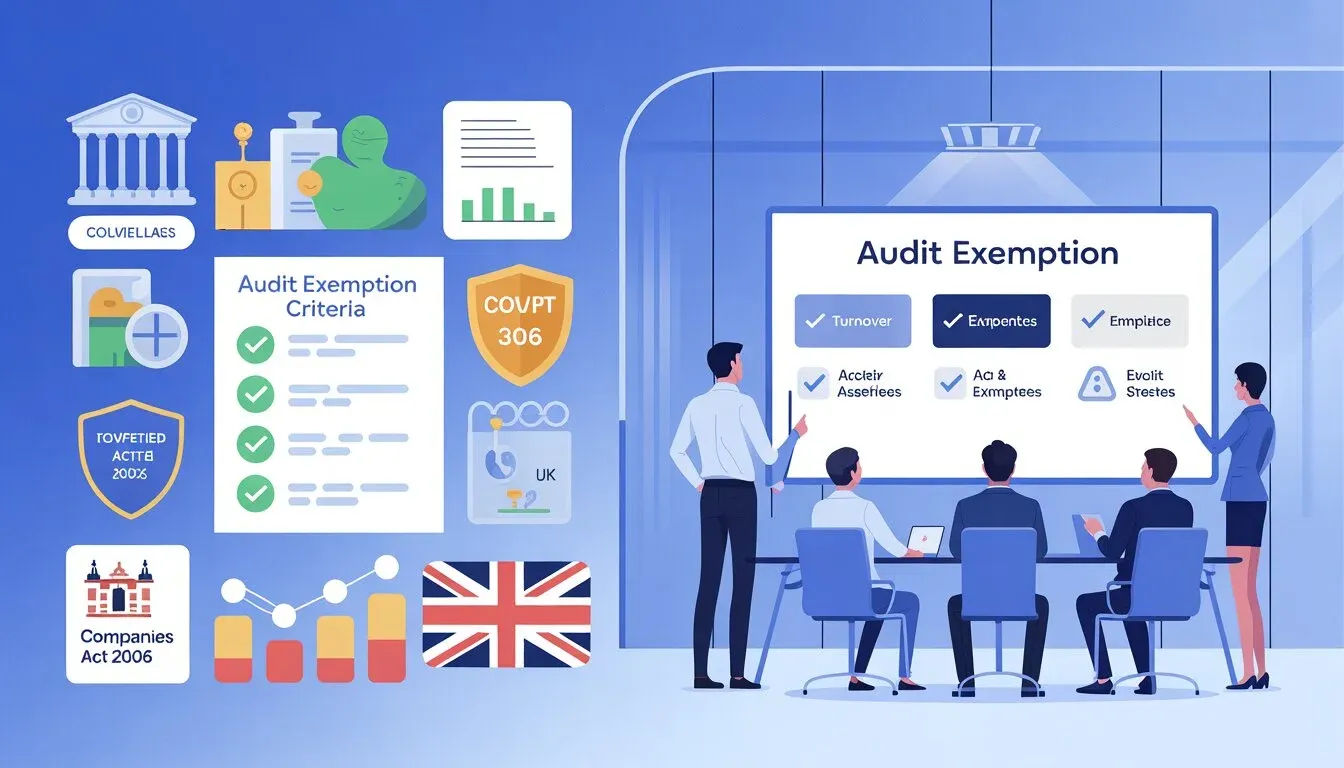
To qualify as a small company for audit exemption purposes, you must meet at least two out of three size criteria for the relevant financial year.
For financial years beginning between 1 January 2016 and 5 April 2025, the limits are:
- Turnover of no more than £10.2 million
- Balance sheet total (assets) of no more than £5.1 million
- 50 or fewer employees on average
For financial years beginning on or after 6 April 2025, the turnover and balance sheet limits are expected to increase (while the employee limit remains 50). Directors should check the latest thresholds or seek professional advice to confirm which set of limits applies to their year‑end.
However, most countries base their criteria on the following key factors.
1. Company Size: Turnover, Assets, and Employees
Company size is one of the most common measures to determine whether a private company should undergo an audit. The company must meet the criteria of certain limits for turnover, total assets, and average number of employees. If it wants to benefit from an exemption. This is typically what those factors look like:
- Annual Turnover: One of the main factors in determining if a company is eligible for an audit exemption or not. In many different countries, there is a threshold for annual turnover (which when crossed, an audit would be a must). For example, companies with annual turnovers below £10.2 million in the UK, are eligible for an audit exemption. This threshold could be very different in other jurisdictions.
- Total Assets: The total assets of a company have to be considered at the end of the financial year, as well. If a company’s assets fall below a specified limit, it may be exempt from an audit. It is not necessary under UK law to subject a private company with assets below £5.1 million in the country.
- Number of Employees: Employee headcount is also important to establish whether a company needs to have an audit or not. Smaller businesses with fewer staff members are exempt. In the UK, a company that has 50 or fewer employees can escape an audit while in some countries that limit is zero. Similar thresholds exist in other countries, such as 10 or 25 employees, depending on local regulations.
2. Company Type and Structure
The legal form of a company also plays a role in whether or not an audit is required. Some company types, regardless of size, must submit to audits due to the nature of their operations or ownership structure.
- Many banks, insurance companies, and other public interest entities irrespective of their size are mandated to get audited. This is largely due to the sectors in which they operate (with a need for financial transparency and stakeholder trust.)
- For a private firm being part of a larger group (i.e. having parent company or subsidiary companies), audit requirements can depend on the consolidated financial statements of the group. If the group exceeds certain size thresholds, the company may still need to conduct an audit even if it qualifies for exemption on an individual basis.
3. When Shareholders Request an Audit
Even if your company usually doesn’t need an audit. You must have your accounts audited if shareholders owning at least 10% of shares (by number or value) request it. This can be one shareholder or a group. They need to send a written request to your company’s official address.
The request should reach you at least one month before the end of the financial year for which they want the audit.
This allows a stakeholder to request an audit of the company’s financial reporting or management. If they are concerned, increasing accountability and transparency within the businesses.
4. Small Company Audits
Small businesses may choose to have an audit even if they do not find it legally required. This can happen for several reasons:
- Their bank asks for an audit
- Someone giving them money wants an audit done
- The directors or shareholders may want audit assurance
- The company’s rules may demand it
- To prepare for a future business sale or public offering.
Why Choose Reflex Accounting for Your Audit?
At Reflex Accounting, our audits are designed to add value, not just meet a statutory requirement. We combine technical expertise with a practical, commercial approach so directors get clarity, not complexity.
- Deep experience in UK audit and assurance for small and growing private companies.
- Risk‑focused approach that targets key areas instead of disrupting your whole business.
- Clear, jargon‑free reporting with practical recommendations you can implement quickly.
- Support with both statutory and voluntary audits, including group and specialist engagements.
- Ongoing advisory input to help you use audit insights to strengthen controls and plan future growth.
Contact our team of Auditors and get the free consultation today
Final Thoughts
Given the potential impact on cost management, compliance, and tracking financial information, having a grasp of the criteria for audit requirements and exemptions is quite essential. Even if official audits are not mandatory for small companies. There is also the question of whether you would be better off with an audit considering your circumstances and aims.
On the other hand, if your company finds it essential to have an audit. Knowing these criteria will allow you to plan and budget for this important process.
Ultimately, whether exempt or not, conducting an audit can boost confidence among stakeholders. It improves internal financial controls and supports long-term business success.
Faqs:
1. What is audit exemption for private companies in the UK?
Audit exemption means a qualifying private limited company can file unaudited statutory accounts, instead of having an independent auditor express an opinion on them, provided it still meets all Companies Act 2006 accounting and disclosure requirements.
2. What are the current size limits for audit exemption?
3. Do the audit exemption limits apply to groups?
Yes. If your company is part of a group, the turnover, assets and employee tests are applied to the group totals, and you normally need to meet the criteria for two consecutive years to keep the exemption.
4. Which companies cannot claim audit exemption, even if they are small?
Public companies, banks, insurers, certain investment and pension bodies, and companies with traded shares on a regulated market generally cannot claim exemption, regardless of size.
5. If I qualify for audit exemption, do I still need an accountant?
Yes. You still have to keep proper accounting records, prepare compliant accounts and include the correct audit‑exemption statement on the balance sheet, so most directors rely on an accountant to help them get this right.
6. Can shareholders or lenders still insist on an audit?
They can. Your articles of association, shareholder resolutions or loan agreements may require an audit even where the Companies Act would allow exemption.