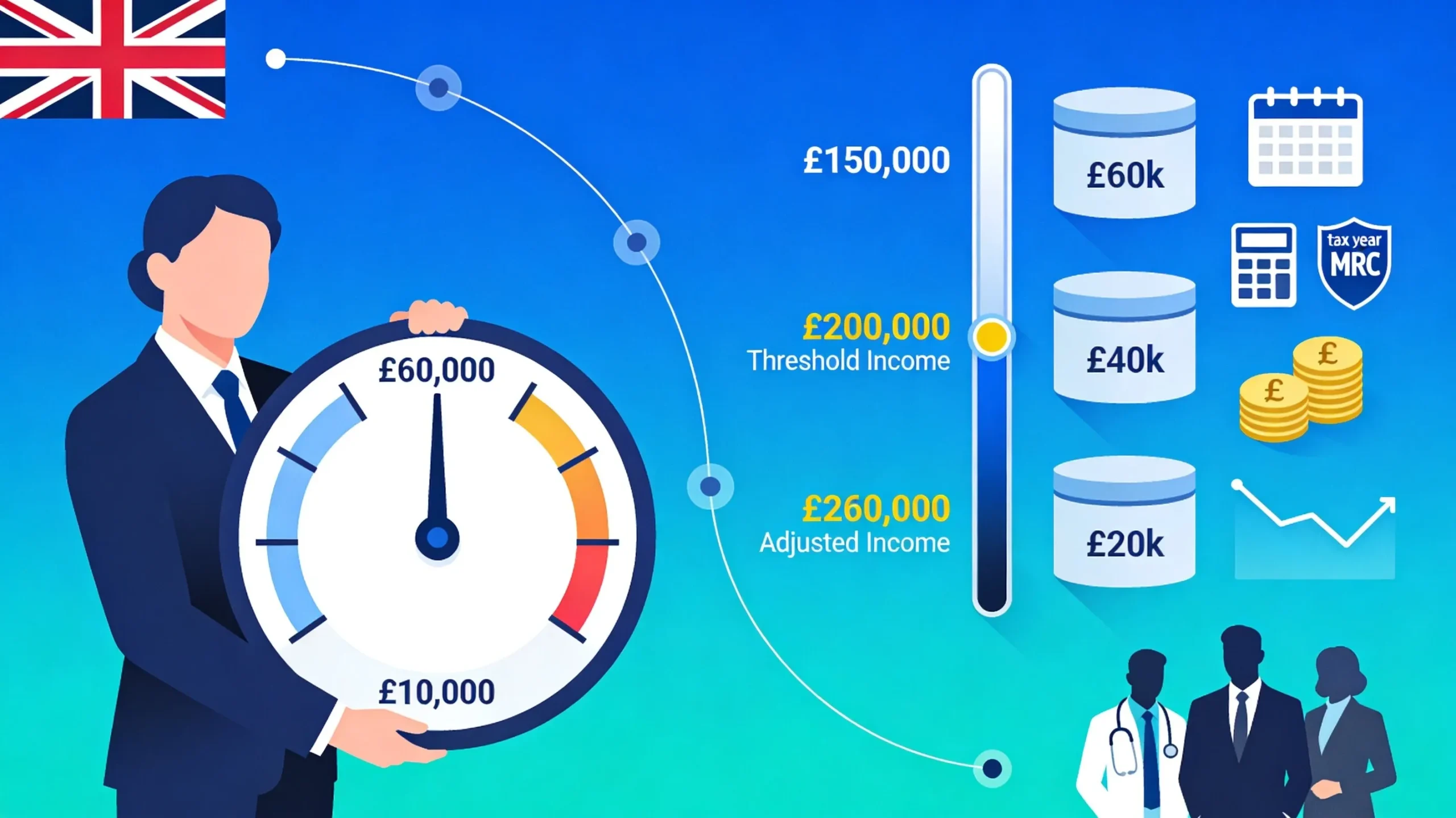
The tapered annual allowance is one of the most intricate tools for pension savings. This provision materially impacts net pension contributions and overall tax efficiency. Once income rises beyond a certain point, HMRC starts restricting the pension saving that can receive tax advantages in a tax year. This guide provides a precise and compliance-oriented overview of the rules which are applicable in the current 2025/property income26 tax year.
What is the Tapered Annual Allowance?
The Tapered Annual Allowance is the mechanism that reduces the standard pension annual allowance for high earners. It is designed by HMRC to limit the tax advantages of pension contributions for higher-income individuals. In the UK, annual allowance is the maximum amount you can contribute to your pension each tax year and still claim tax relief. The current rate is £60,000 for most people in the 2025/26 tax year.
However, if an individual’s income profile crosses a certain limit, the allowance is “tapered” rather than remaining at the default £60,000. It can be potentially down to as low as £10,000. It is a gradual and formula-driven reduction that is designed to target tax relief more narrowly at those with the greatest capacity to save and benefit from it. It ensures the pension system remains fairer across income brackets. But for those who are affected by it, it means careful planning to avoid unexpected tax bills.
Threshold vs Adjusted Income: Key Taper Tests
The taper is only applicable in cases where threshold income exceeds £200,000 and adjusted income exceeds £260,000. If one of these amounts remains within its limit, no taper applies. There are other allowances, such as the Money Purchase Annual Allowance, that can reduce an individual’s allowance.
Threshold Income
The calculation of threshold income starts with the gross income of an individual for the tax year. This includes any income arising from salaries, bonuses, self-employment earnings, rent, dividends, savings and taxable pension income. There are also some other adjustments made. Gross pension contributions made under relief at source are deducted, as well as some of the lump sum death payments that are taxable. Any income that is sacrificed under salary or flexible remuneration arrangements that were put into place on 8 July 2015 is added back. The employer’s contribution is not automatically subtracted from this amount. If the threshold income is £200,000 or less, tapering is not applicable.
Adjusted Income
When threshold income exceeds £200,000, it is also necessary to calculate adjusted income. Adjusted income generally includes pension contributions by employers and the amount required to offset certain types of pension contribution relief. It is not always calculated by adding all the pension contributions to threshold income. When adjusted income is £260,000 or less, tapering does not take place.
How is the Tapered Annual Allowance Calculated?
The tapered annual allowance becomes relevant only when threshold income is over £200,000 and adjusted income is over £260,000. Both criteria need to be fulfilled. To calculate the tapered annual allowance correctly, please follow the steps below:
1. Check Your Threshold Income
Start with the calculation of the taxable income. Deduct all gross member contributions made using relief at source, as well as any taxable lump sum that may be treated as death benefit. Add all income sacrifice in accordance with the respective salary sacrifice and flexible remuneration scheme, provided that such scheme was introduced on or after 8 July 2015. Gross member contributions made under the net pay arrangement have already been taken into account when calculating the employment income.
2. Calculate Your Adjusted Income
Start with net income and make the required pension tax relief and pension input amount adjustments. In the simple case of a defined contribution arrangement with personal contributions being paid via relief at source, this involves adding employer pension contributions to net income. The defined benefit pension saving is measured through the increase in the value of promised benefits, and not just the contributions made by the employee and employer.
3. Implement the Taper Formula
If both breaches occur, then the reduction is calculated as:
Reduction = £1 for every £2 of adjusted income above £260,000
Then you need to subtract this reduction amount from the base allowance of £60,000. Mathematically, it is given by:
Tapered Annual Allowance = £60,000 – (Adjusted Income – £260,000) / 2
But there are two rules which must be followed, which are as follows:
- As of 2025/26, the tapered annual allowance cannot go below £10,000
- If the arithmetic result falls below £10,000, the allowance is set at £10,000 before any carry forward
Practical Example
To make this concrete, let’s consider a real-life scenario based on a client’s tax and pension input data. Sarah is a management consultant in London. In the 2025/266 tax year, her situation is typically like that of many other high earners.
- Salary: £220,000
- Bonus: £50,000
- Dividend income: £10,000
- Her personal gross contribution to a relief at source SIPP: £20,000
- Her employer pension contributions: £30,000
First, the threshold income needs to be calculated like this:
Threshold income = £220,000 + £50,000 + £10,000 – £20,000 = £260,000
Since this is > £200,000, then we need to check adjusted income as follows:
Adjusted income = £280,000 net income + £30,000 employer pension contribution = £310,000
This adjusted income is more than £260,000, so the reduction is calculated as follows:
Excess = £310,000 minus £260,000 = £50,000
Reduction = £50,000 divided by 2 = £25,000
Then apply it to the base annual allowance:
Tapered Allowance = £60,000 minus £25,000 = £35,000
Sarah’s annual allowance is therefore reduced from £60,000 to £35,000. Her total pension input for the year is £50,000, so she has a potential £15,000 excess before considering carry forward. This example assumes that the stated £20,000 SIPP contribution is the gross amount after basic rate relief has been added.
Impacts & Accounting Considerations
Annual Allowance Charge
If Sarah’s total pension contributions in the year exceed £45,000, the excess is subject to the annual allowance charge. Then it will be added to her taxable income and taxed at marginal rates via self-assessment.
Carry Forward
She can utilise unused allowance from the previous three tax years. It will be helpful to mitigate the annual allowance charge. But they must be used chronologically and only if pension scheme membership was in place in those tax years.
Defined Benefit Schemes
Where clients participate in defined benefit schemes, the valuation of pension savings is more complex. HMRC lays out detailed steps for these calculations in its internal manual.
Key Risks & Compliance Considerations
- Salary Sacrifice: Salary sacrifice contributions are added back to the threshold income in many cases, increasing the risk of hitting the taper.
- Carry Forward Nuances: Carry forward is a powerful tool, but it is often overlooked. Careful tracking of unused allowance balances is necessary.
- Rounding: HMRC guidance indicates taper reductions are rounded down to the nearest £1.
How Reflex Accounting Helps High Earners Navigate the Tapered Annual Allowance
At Reflex Accounting, we specialise in pension tax planning for high-earning professionals, including directors, consultants, NHS doctors, and senior executives who face the tapered annual allowance.
We calculate threshold and adjusted income using the statutory adjustments, reconcile pension input amounts across defined contribution and defined benefit schemes, and check the tapered allowance, MPAA and carry forward position.
Faqs:
Who is affected by the tapered annual allowance?
High earners with threshold income over £200,000 and adjusted income over £260,00. This often impacts directors, consultants, senior professionals and anyone receiving a large employer pension.
What happens if I exceed my tapered allowance?
If your total pension savings in the tax year go above your tapered annual allowance, then you need to pay an annual allowance tax charge on excess via Self-Assessment.
Can I use carry forward with a tapered allowance?
Yes, even if your allowance is tapered, you can still use carry forward of unused annual allowance from the previous three tax years, as long as you were a member of a UK-registered pension scheme during those years.
When did annual allowance tapering start?
Annual allowance tapering was introduced in the UK from 6 April 2016, mainly to restrict pension tax relief for higher earners.