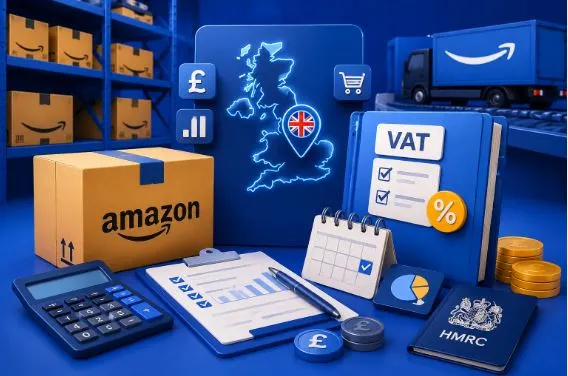
One of the most popular ways to make money online in the UK is through selling on Amazon. However, selling on Amazon often proves to be more difficult than just making sales and withdrawing profits. Many sellers soon discover that there are many tax-related regulations that they must comply with as an Amazon seller in the UK, and there are several penalties or account issues that they may face if they do not comply with the rules set forth by HMRC.
This guide outlines your Amazon seller tax obligations in the UK, explains how taxes work in simple terms and provides tips for staying compliant with your taxes while building your Amazon business.
Understanding Amazon Seller Tax Obligations in the UK
Once your Amazon UK sale activity becomes regular and profit-based, the HMRC considers you to be running a business and tax obligations apply as with any other business in the country. There are generally two approaches in the UK for most Amazon sellers who have commenced working on their business:
- Sole traders: most often the case with beginner or small-scale sellers
- Limited company: normally more common in growing Amazon businesses using the FBA service, for tax purposes, benefits and asset protection.
Both structures have similar tax obligations. Therefore, whatever your organisational structure is, you are responsible for paying the following taxes: Income Tax, National Insurance (sole traders), Corporation Tax (limited company), and if your turnover exceeds the VAT threshold, you will also need to complete a VAT registration application.
What Taxes Do Amazon Sellers Pay in the UK?
Different taxes may apply to Amazon sellers depending on their business structure and annual turnover in the UK
Income Tax
Profits will be taxed through the Income Tax Bands after deducting any allowable expenses that were incurred in earning the profit.
Self-Employment Taxes
If you are a self-employed seller, you will also be required to pay Class 2 and Class 4 National Insurance Contributions as part of being self-employed.
Corporation Tax
If you operate as a limited company, any profits you make from being a FBA Seller will be taxed under Corporation Tax rather than Income Tax.
VAT
VAT registration becomes compulsory once your taxable turnover exceeds the UK threshold or is voluntarily registered for the sake of business benefits.
Whether VAT registration is compulsory depends on your taxable turnover, not your net profit.
UK Tax Requirements for Amazon FBA Sellers
Sellers who use Amazon’s FBA can find their tax compliance complex. Tax compliance is more difficult when there is automated fulfilment, storage in multiple countries, and multiple fee structures. As a seller on Amazon, you need to track:
- The Referral and FBA fees charged by Amazon
- The storage and fulfilment fees charged by Amazon
- The costs of advertising and PPC
- The cost of inventory purchases and shipping
- Cross-border VAT (if selling internationally)
Many sellers often underestimate the number of deductions they can claim within their Amazon account data. If you do not properly track your expenses, you may understate your taxable profits, which can lead to additional taxes owed to HMRC, or may put you at risk of being investigated by HMRC due to non-compliance. To avoid these issues, you may need an accounting expert. Reflex Accounting can help to reduce these risks and stay compliant.
Tax Compliance for Amazon Sellers: What HMRC Expects
The HMRC expects Amazon sellers to maintain full transparency and record-keeping of all income and expenses. This includes the following:
- Recording every payment received from Amazon
- Keeping track of all business expenses (including Amazon fees)
- Collecting and maintaining all invoices for inventory purchases and shipping charges
- Submitting an accurate annual tax return
- Keeping VAT records if you are VAT registered
Tax compliance for Amazon sellers will not only involve submitting annual tax returns to the HMRC, but also maintaining a consistent financial record-keeping function throughout the entire year.
How Do I Calculate Taxable Profit from Amazon Sales?
One of the most important calculations for Amazon sellers is determining taxable profit correctly.
Your taxable profit is:
Amazon Sales Revenue – Amazon fees (FBA, referral, storage) – Cost of goods sold (inventory purchase cost) – Shipping and import costs – Advertising and marketing expenses – Other allowable business expenses = Taxable Profit
This figure is what HMRC uses to calculate your tax liability. Many Amazon sellers mistakenly pay tax on total revenue instead of profit, which leads to unnecessary overpayment.
Common Amazon Tax Mistakes Sellers Make
Many Amazon sellers in the UK face compliance issues due to avoidable mistakes, such as:
- Not separating personal and business expenses
- Ignoring VAT obligations when scaling
- Miscalculating inventory costs
- Failing to track Amazon fees accurately
- Not maintaining real-time bookkeeping records
These issues usually arise when sellers rely on manual tracking instead of structured accounting systems. Therefore, a specialist is required who can handle these issues, such as Reflex Accounting.
How Reflex Accounting Helps Amazon Sellers Stay Fully Compliant
Managing Amazon tax obligations becomes significantly easier with our specialist accountants for Amazon FBA sellers. Instead of reacting at year-end, they help Amazon sellers build a proactive financial system that supports growth and compliance from the start.
Reflex Accounting approach focuses on making Amazon accounting accurate, efficient, and stress-free by:
- Creating complete bookkeeping systems customised for Amazon FBA merchants
- Ensuring compliance with all relevant UK tax laws for Amazon sellers
- Calculating the tax on profits from Amazon sales accurately
- Assisting with VAT registration, filing returns, and working through cross-border issues
- Finding all business expenses that can be claimed for tax purposes
- Preparing and submitting self-assessment or company tax returns on time and accurately.
With proper accounting support, sellers gain clarity on real profitability instead of relying on estimated figures inside Amazon dashboards.
FAQs:
Do I need to pay tax on Amazon sales in the UK?
Yes, if you sell on Amazon regularly, you will need to pay taxes on your profits (not total sales) after deducting any allowable expenses.
When do Amazon sellers become liable for tax?
You become liable for tax once you begin trading with the intention to make a profit. At this point, you are required to register with HMRC and report any income earned from those sales.
Does Amazon automatically deduct tax from my earnings?
No, Amazon will not take taxes from your earnings. You will receive the full amount you have earned, and you will be responsible for calculating and paying any taxes owed to HMRC.
Do I need a limited company to sell on Amazon UK?
No. You can begin selling on Amazon UK as a sole trader. However, many people eventually create a limited company for reasons such as growth, taxation planning, etc.
What is the difference between income tax and VAT for Amazon sellers?
Income tax is paid on profits, while VAT is charged on sales turnover if you pass the VAT threshold. VAT is collected from customers and reported to HMRC separately.