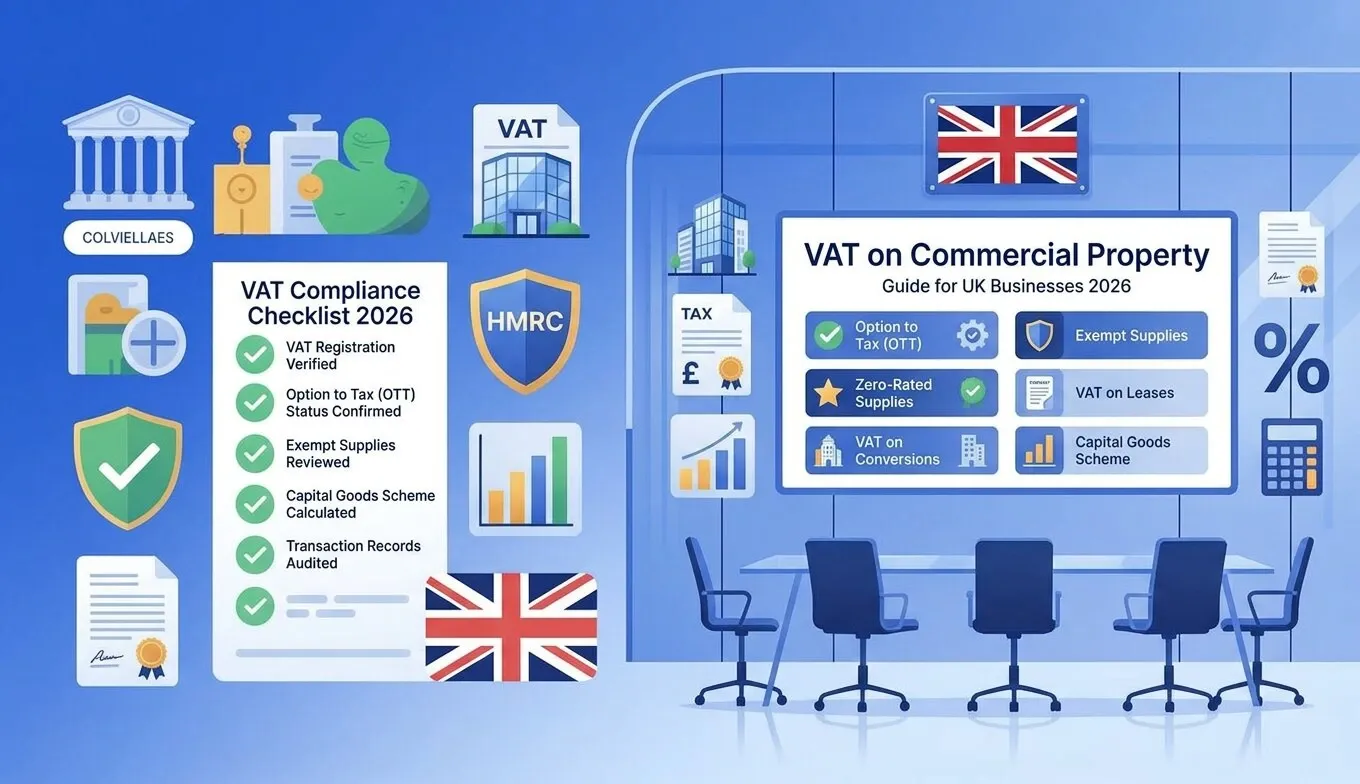
As tax rules continue to evolve, it is essential to understand how VAT affects commercial property in the UK. Whether you are buying a building, leasing office or retail space, or investing in commercial real estate, the VAT position can have a major impact on cost, cash flow and recoverability of input VAT. This guide explains how VAT on commercial property works and highlights key points to consider so you can make informed decisions for your business.
What is VAT on Property?
There is a consumption-based value-added tax (VAT) on many types of goods and services purchased in the UK, including VAT on commercial properties. Commercial property transactions can be:
- Exempt from VAT
- Standard-rated (usually 20%)
- Outside the scope of VAT
But the rules governing VAT in connection with property are somewhat different from the rules governing other goods and services because property transactions can either be exempt from VAT, receive a standard rate of VAT, or be outside of the scope of VAT altogether. Generally speaking, VAT applies to commercial properties that are used in the conduct of business, i.e., the sale or lease of non-residential buildings, such as offices, retail halls or industrial units. As a general rule of thumb, a commercial sale or lease of real estate in the UK is VAT exempt. It means that a buyer or a tenant generally does not have to pay VAT. This can make buying or renting commercial property much more attractive for everyone’s cash flow purposes.
However, a transaction that is VAT exempt does not allow the seller of the property the ability to recover any VAT incurred on costs that relate to the property being sold or leased. Because of this, some property owners use the “option to tax” method to apply VAT to the property.
When VAT Applies to Commercial Property
Although many property transactions are exempt from VAT, there are several situations where VAT on commercial property becomes payable.
- New Commercial Property
If a commercial property is less than three years old, the sale or lease is normally subject to VAT at the standard rate of 20%. For example, a newly constructed office building, a recently developed retail unit or a newly completed warehouse. In these cases, buyers may need to pay VAT on the purchase price.
- When the Owner has Opted to Tax
Commercial property owners can choose to charge VAT by making an “option to tax”. This means they must charge VAt on sales, rents or other supplies related to that property. The main reason owners opt to tax is to recover VAT on property-related expenses, such as renovation costs, construction work or professional fees. However, once the option is made, it can be withdrawn within initial 6 month cooling-off period or remain in place for around 20 years, otherwise irrevocable. This makes it a long-term decision.
VAT on Property Purchase & Key Considerations
When buying commercial property, the VAT position depends largely on the seller’s and the property’s status. For older commercial properties, most with a time period of over three years, purchases are usually VAT-exempt unless the seller has made an “option to tax” election. This election allows the seller to charge 20% VAT on the sale price, which enables them to recover input VAT on their own expenses. It is important to note these points:
- If the property is VAT-exempt, then no VAT is charged on the purchase price, the transaction is simple for buyers, and the seller cannot reclaim VAT on related costs.
- If the property is VAT-taxable, then VAT is charged at 20% on the purchase price. VAT-registered buyers may reclaim the VAT, depending on their business activities and cash flow planning becomes important due to the higher upfront cost.
This is the reason why buyers must carefully review contracts and tax status before completing a property transaction.
Transfer of a Going Concern (TOGC)
A TOGC occurs when a property that is part of an ongoing business is sold to a buyer who intends to continue operating that business. In this case, when certain conditions are met, then the transactions may be outside the scope of VAT, no VAT is charged on the property purchase, and the buyer effectively takes over the existing business activity. This structure is commonly used to avoid large VAT charges on property investments.
Do Businesses Pay VAT on Purchases?
Many companies pay VAT on goods and services purchased from registered suppliers each time they buy these products. Companies registered for VAT can take back VAT through VAT returns if the purchases relate to the company’s taxable trading activity. The VAT registration threshold you will need to register for 2026 is £90,000 of taxable turnover within a 12-month rolling period.
If this amount exceeds the limit, you are required to register for VAT, charge VAT on sales, and reclaim input VAT on all qualifying purchases as they relate to taxable business activities. In relation to obtaining commercial property, a VAT-exempt sale means that you do not need to pay any VAT at the time of acquiring the property, but it also means that you cannot recover the associated input VAT. Conversely, zero-rated sales allow for input VAT to be recovered. However, you do not charge your customers any VAT.
Why Property VAT Planning Matters?
Property transactions involve large sums of money. So, VAT on commercial property can significantly affect overall costs. Poor planning may lead to unexpected VAT charges, cash flow issues during property purchase and inability to recover VAT on renovation or development costs. Due to this, businesses and investors should always review the VAT status of a property before signing any contracts.
How Reflex Accounting Supports You?
Managing VAT for commercial properties can be complicated, as the rules will depend on a variety of factors that influence how VAT applies to your commercial property, such as the type and age of the property. Our specialist VAT accountants at Reflex Accounting help businesses understand when VAT will apply and how to structure transactions efficiently.
We:
- Minimise the chances of businesses being hit with unexpected tax liabilities as a result of VAT. For example, if a business is purchasing a property, we will carry out a thorough review of the VAT position associated with the transaction,
- Establish whether the seller has made an election to tax that property and assist in structuring the purchase in the most efficient tax way.
- To assisting businesses with VAT compliance and ensuring that records and VAT returns are compliant with the relevant rules of HMRC, we help those businesses that are eligible reclaim some of the VAT paid on the cost of purchasing goods and services.
If you need dedicated support beyond commercial property, our specialist VAT accountants can also assist with wider VAT planning, registrations and returns across your business.
Faqs:
What is the standard rate of VAT on commercial property?
When VAT applies to commercial property transactions, it is usually charged at the UK standard VAT rate of 20%. This can apply to new commercial buildings or properties where the owner has chosen to charge VAT.
Are commercial property rents subject to VAT?
Commercial property rents are normally exempt from VAT. However, if the landlord has made an option to tax, VAT may be charged on the rent at the standard rate.
What does ‘option to tax’ mean on commercial property?
An option to tax allows a property owner to charge VAT on a commercial property that would normally be VAT-exempt. This is often done so the owner can reclaim VAT on property-related costs, such as construction, refurbishment or professional fees.
Can a commercial property sale be exempt from VAT?
Yes, many commercial property sales are VAT-exempt, especially older properties where the owner has not opted to tax. In some cases, a sale may also fall outside the scope of VAT if it qualifies as a transfer of a going concern.
How does VAT affect Stamp Duty Land Tax (SDLT) on commercial property?
If VAT is charged on the purchase price of a commercial property, it is usually included in the amount used to calculate Stamp Duty Land Tax (SDLT). This means the overall SDLT liability may increase when VAT applies.