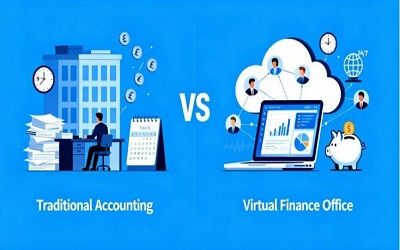
As the finance world is evolving at a remarkable speed, UK businesses are experiencing this shift more than ever. Organisations increasingly need to to reassess their financial operations management due to rising competition, changing tax regulations and increasing demands for real-time data. Even though traditional accounting is the backbone of every organisation’s financial operation, it is now challenged by an alternative way that is introduced by the digital age, the Virtual Finance Office. Recent data report from Wolters Kluwer that 47% of UK accountants are now utilizing cloud accounting, while other reports show 80% of accountant firms outsourced some of their tasks in the past years (QuickBooks UK, Accountant Trends, 2025).
These modern, tech-driven solutions offer flexibility, automation, and real-time insights that many businesses find hard to ignore. As more companies are choosing virtual accounting services and remote bookkeeping services, the debate of Virtual Finance Office vs Traditional Accounting has become central to financial decision-making. Because of this, understanding the key differences between traditional accounting and virtual finance offices has become essential for choosing the right financial management approach.
What is a Virtual Finance Office?
A Virtual Finance Office (VFO) is a digital and outsourced alternative to traditional in-house finance systems that not only offer bookkeeping, but also cover payroll, VAT, management reporting and cashflow management. Many VFOs now offer the services of the Fractional Chief Financial Officer (Fractional CFO) that provides the strategic tax planning, growth strategies, financial resource planning and accounts management services. It provides businesses with flexible access to expert financial leadership without hiring full-time staff, which is very beneficial for small- and medium-sized businesses that cannot afford a permanent in-house team. Such a growing model is spreading quickly in the UK due to the skill shortages, and the demand for cost-efficient, real-time financial insight which is future oriented instead of looking at historic information. It helps in making real-time decisions as well as tracking business performance and KPIs.
Key Features of Virtual Finance Office
- Bookkeeping and digital accounting via platforms like Xero, QuickBooks and Sage
- Payroll, Pensions, VAT and Compliance management
- Accounts Management
- Cash flow forecasting, budgeting and financial analysis on a monthly or weekly basis
- CFO or financial controller expertise on demand
- Strategic tax planning
- Growth strategies planning
- Financial resource planning
- Real-time financial dashboards for instant insights
What is Traditional Accounting?
Traditional Accounting is a long-established classical model where businesses manage their finances via in-house finance manager and assistant accountants and utilise manual processes and physical workflow. It is the most familiar method, which provides hands-on control, personal association and one-on-one interactions but lacks the flexibility, speed and automation of modern digital finance models.
Cost of In-House Team
The major limitation for a small or medium sized business is that a traditional in-house team needs more cost for management and space as well. In-house teams need a proper office space, equipment, computer systems, licence, desks and other tools for performing to do their job. Hiring the finance staff and training the new employees also require the cost expense and it is also a time consuming process. A complete team is required to run the finance department of a company if they choose an in-house team which costs higher salaries. The average value of salaries are following:
- Bookkeepers range salary of £22,000 – £30,000 per year
- Accountants range salary of £30,000 – £50,000 per year
- Financial Controller range salary of £50,000 – £75,000 per year
- Benefits of employees range near about £13,000 (20%) for 2 employees
Key Features of Traditional Accounting
- In-house Finance Staff hiring bookkeepers, accountants, payroll clerks and finance managers
- Manual or Semi-manual workflows using paper invoices and spreadsheets
- Periodic Financial Reporting is often quarterly or yearly
Virtual Finance Office vs Traditional Accounting – Key Differences
| Feature | Traditional Accounting | Virtual Finance Office (VFO) / Fractional CFO |
| Cost | Higher overhead (salaries, office space); In UK, 25 leaves must be provided and additional leaves are also provided that must be paid | More cost-efficient, no full-time salaries required, No need of holiday pay, pensions and training costs |
| Team Expertise | Full-time in-house staff with limited experience or lower level of experience | Scalable team; fractional CFO or VFO services available, Level of expertise are higher and offer multiple task management |
| Flexibility | Fixed resources, limited scalability | Pay-as-you-go, can scale services up or down |
| Reporting | Periodic (quarterly, yearly) | Real-time financial insights and management reports (weekly or monthly reporting) |
| Compliance & Advisory | Largely depends upon historic data, relies on accountant expertise which are limited | Proactive compliance, advisory, tax planning and forecasting capabilities |
| Use Case | Firms preferring direct control and traditional workflows | SMEs and growing businesses seeking flexibility, efficiency, and strategic insight |
| Strategic Tax planning | Do not offer much strategic tax planning | Plan the strategic tax via minimizing tax liabilities and maximize after-tax returns |
| Location | On-premises | Cloud-based, fully digital |
| Accessibility | Limited to office hours or in-person meetings | Accessible anywhere, anytime through digital platforms |
Why Choose Reflex Accounting as Your Virtual Finance Partner
Choosing the right finance partner is critical for business growth, and Reflex Accounting has established itself as a trusted and forward-thinking partner. Their Virtual Finance Office model is specifically designed for the organisations looking for accuracy, transparency and long-term stability. Unlike many traditional services that operate on fixed schedules, Reflex Accounting offers proactive support, identifying the risks and opportunities before they escalate. Their services are cost-effective, flexible and tailored to fit the unique needs of each organisation. Here’s why:
- Expertise On Demand: Access a team of experienced and specialised financial strategists, and no need to hire full-time staff, benefiting especially small-scale businesses. Reflex offers fractional VFO services to provide high-level guidance whenever you need it.
- Technology-Driven Solutions: Implementing the latest cloud accounting platforms, automation, and real-time reporting tools to provide accurate and up-to-date financial insights, whether firms need these on a weekly or monthly basis.
- Cost-Efficiency: With flexible VFO services, firms need to pay only for what they need. It saves on salaries, office overheads and administrative costs.
- Continuity & Reliability: Reflex Accounting ensures financial operations run smoothly, even during staff absences or busy periods and provides peace of mind and uninterrupted support.
- Compliance & Advisory: Reflex Accounting keeps any business fully compliant with UK regulations while it also offers proactive advice to help your business grow.
- Scalable for Growth: Whether you’re a small business or a fast-growing SME, Reflex Accounting services scale with your needs and provide strategic financial management at every stage.
Conclusion
In today’s fast-evolving business trends and increasing financial complexity, UK organisations clearly need a more efficient way for managing the accounts. It’s not just preference between Virtual Finance Office and Traditional Accounting, but it’s a strategic decision that shapes how efficiently a business can operate in a fast-paced digital economy. Although Traditional accounting is the most familiar way of managing finances and still has value, its limitations are becoming more apparent as now firms need agility and deeper strategic insight.
On the other hand, A Virtual Finance Office or fractional CFO, like Reflex Accounting, provide real-time insights, continuity and scalable expertise at a cost-efficient rate. For businesses to grow with confidence, the shift towards digital and flexible finance support is no longer just a trend but a practical step towards long-term stability and smarter decision making. By combining technology, automation, and strategic financial guidance, Reflex Accounting empowers businesses to stay compliant, make smarter decisions and focus on growth that makes it the ideal finance partner for modern UK business.