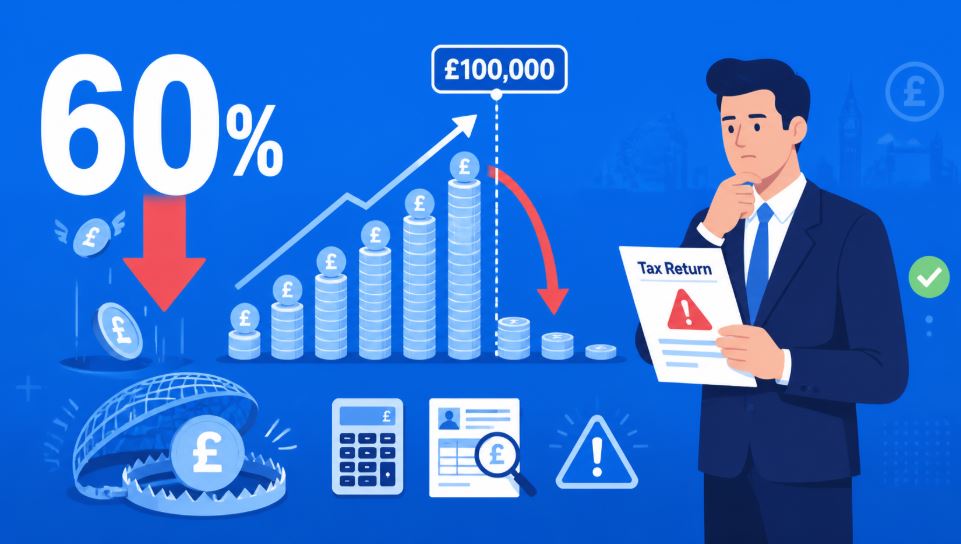
In the financial year 2025-26, an anticipated 725,000 UK employees can be taxed at 60%, with income ranging from £100,000 to £125,140. This figure is more than twice as high as the number of persons affected in 2017-18, which is over 300,000.
This rise is mostly caused by financial drag. The Personal Allowance and Income Tax threshold of £12,570 has stayed consistent, although income levels have risen, putting more people in the £100,000 to £125,140 group. There is no distinct 60% income tax bracket. This is caused by the loss of the Personal Allowance for each. Professionals who receive bonuses, raises, or increased income can end up paying high taxes. Without taking into account National Insurance, you effectively only keep 40p of every extra £1 you make in England, Wales, and Northern Ireland.
What Is the £100k Tax Trap?
In the UK, nearly every taxpayer receives a £12,570 Personal Allowance. However, if your adjusted net income exceeds £100,000, your allowance can be reduced by £1 for each £2 over the cap. When income hits £125,140, the allowance can be fully eliminated. Incomes between £50,271 and £125,140 are subject to the 40% higher income tax rate in England, Wales, and Northern Ireland.
However, the progressive reduction of the Personal Allowance leads to an increased tax burden. For incomes between £100,000 and £125,140, the combination results in an effective marginal rate of 60%. Scotland has distinct income tax bands. Incomes between £75,001 and £125,140 are subject to the 45% Advanced Rate in 2025–2026. The effective marginal income tax rate might reach 67.5% as a result of the Personal Allowance tapering.
How Much Extra Tax Could You Actually Pay?
There is no new formal tax bracket created as a result of the £100k tax trap. Rather, it raises the effective marginal rate for every pound earned above the £100,000 adjusted net income. You must pay the applicable higher or additional rate of income tax on your income and lose £1 of your personal allowance for each extra £2 beyond £100,000. As a result, the effective marginal income tax rate in England, Wales, and Northern Ireland is 60%. Due to the 45% Scottish rate, the comparable percentage in Scotland is 67.5%.
A Worked Example: £100,000 to £125,140 Income Band
A simple calculation can show how the mechanics of the £100k tax trap operate. Every £2 of income received above £100,000 is taxed at a higher rate of 40% in England, Wales, and Northern Ireland. This generates £0.80 in income tax. In addition, you are losing £1 of your Personal Allowance, which is normally tax-free. As a result, the reduction in the Personal Allowance generates an additional £0.40 in income tax at the higher rate of 40%. As a result, you pay £1.20 in income tax for every additional £2 of income. In effect, the actual marginal income tax rate is 60%. National insurance and other deductions, such as student loan payments, are excluded from the computations.
When adjusted net income hits £125,140, the Personal Allowance is fully exhausted. Additional income is taxed at the usual marginal rate, which is 45% in England, Wales, and Northern Ireland for incomes over £125,140.
England, Wales and Northern Ireland versus Scotland’s 67.5% Rate
Since the tax rate in England, Wales, and Northern Ireland is 40%, 60% is applicable in these situations. Employee National Insurance can boost this marginal rate even further. The employee National Insurance rate in 2025-26 is 2% higher than the maximum salary limit. The employee’s total marginal rate is thus calculated to be 62% without any extra deductions.
In Scotland, the tax bands differ. For 2025-26, the 45% Advance Rate is applied to earnings ranging from £75,001 to £125,140. Taking the loss of the Personal Allowance into account, the effective marginal income tax rate is 67.5% on income between £100,000 and £125,140. If necessary, it can be supplemented by National Insurance contributions and student loan repayments. The real amount varies greatly depending on the circumstances and cannot be termed a uniform rate for all Scottish taxpayers.
How to Avoid or Reduce the £100k Tax Trap
The £100,000 tax trap is based on adjusted net income, not gross wage. Some tax planning strategies can therefore reduce adjusted net income while preserving or even increasing the Personal Allowance. Examples include pension payments, qualified salary sacrifice plans, and Gift Aid donations. However, the tax effects of various schemes vary depending on their design, so any calculations should be done carefully before making a choice. It can also have an impact when bonuses or other variable income are earned. If the employer can select the payment date, this revenue can be spread between tax years, avoiding the possibility of having to pay tax on a large adjusted net income in one of them, which can range from £100,000 to £125,140.
Pension Contributions to Bring Income Back Below £100,000
Pension payments can reduce your adjusted net income and help you recover your Personal Allowance in full or in part. Depending on the pension requirements and your specific circumstances, pension contributions can be tax deductible. HMRC has verified that eligible pension contributions are deducted when calculating adjusted net income.
If your adjusted net income is somewhat more than £100,000, your qualifying pension contribution can bring it below the threshold. It can result in a lower loss of Personal Allowance while increasing your retirement savings. The pension yearly allowance for the financial year 2025/26 is fixed at £60,000. You can carry forward unused yearly allowances from the past three tax years. For higher-income persons and those who have flexible access to their pensions, the issue becomes slightly trickier.
Salary Sacrifice Schemes
The salary sacrifice permits employees to give up a portion of their compensation in return for specific non-cash benefits from their employers. In basic terms, this includes company contributions to pension funds, electric vehicles and bicycles, and other such incentives. If the salary sacrifice is eligible, it reduces your cash pay. As a result, adjusted net income can be reduced and maintained at less than £100,000. The tax and National Insurance issues can differ depending on the nature of the benefit acquired. Certain employer-provided perks qualify for specific tax and National Insurance relief. Workplace childcare facilities, among others, are eligible for such treatment under certain conditions.
Charitable Donations Through Gift Aid
Gift Aid donations can potentially lower adjusted net income. If the Gift Aid gift you made is valid, HMRC can assess it after basic-rate tax and deduct the grossed-up amount from your adjusted net income. In other words, £1.25 is normally deducted from adjusted net income for each pound contributed through the Gift Aid system. It is also possible to claim higher-rate and additional-rate Income Tax relief on qualified Gift Aid gifts. It can be done through self-assessment or, in some cases, the tax code. If you are likely to surpass the £100,000 limit, it can be good to consider both pension contributions and Gift Aid donations.
Spreading Bonuses or One-Off Payments Across Tax Years
A significant incentive or other lump sum payment can end up in adjusted net income surpassing £100,000 in a single tax year. If an employer has some flexibility about the date of payment, it is advisable to consider the date of payment before agreeing on the bonus. The tax consequences differ depending on the actual receiving date of the income and the parameters of the employment contract. It is critical not to think that just seeking a delayed payment can transfer the revenue to the following tax year. If you often get bonuses or other variable payments, careful preparation with your employer and tax consultant can enable you to examine the tax consequences before a payment triggers the Personal Allowance tapering scheme.
Common Mistakes People Make With the £100k Tax Trap
The £100k tax trap continues to confuse people. High-income earners often base their tax planning on income tax bands, neglecting the Personal Allowance taper, which has a significant impact on their overall tax status. Misunderstandings about adjusted net income, pension allowances, and even the multiple Scottish income tax rates can lead to poor planning and missed chances to mitigate the effect.
Ignoring Adjusted Net Income vs Gross Salary
Adjusted net income is not the same as pay. It can include salary income, rental income, taxable benefits, dividends, and other types of taxable income after certain adjustments, such as pension contributions and Gift Aid. Simply having an annual salary of less than £100,000 does not imply that you do not qualify for the Personal Allowance taper. Additional income from elsewhere can increase your adjusted net income above the limit. Someone with a salary just below £100,000 can move into the £100,000-£125,140 bracket by earning bonuses, rental income, and other sources of taxable income. Only when one evaluates their overall adjusted net income can they understand the level of their danger.
Missing Pension Annual Allowance Limits and Carry-Forward Rules
Pension contributions can be utilised in order to cut down your adjusted net income. However, this does not mean that you are able to make any money tax-free. For 2025-26, the default annual allowance stands at £60,000. The annual allowance can vary according to the salary of the individual, pension scheme and contributions. People with higher salaries can be subject to a tapered annual allowance, while those who have flexibly accessed their pension benefits can come under the money purchase annual allowance.
If certain criteria are met, an individual can use their allowance from the last three years. In the case of defined benefit pension schemes, one should be very careful as the allowance calculation depends upon the increase in value of pension income. Not analysing your annual allowance and pension contributions can lead to an annual allowance tax charge.
How Reflex Accounting Can Help You Plan Around the £100k Tax Trap
At Reflex Accounting, our skilled accountants evaluate your whole income position, including salary, bonuses, taxable benefits, rental income, and dividends. This enables us to calculate your adjusted net income and assess if you are subject to the £100,000 tax trap.
Our experts then assist you in determining the best alternatives for you, which can involve pension contributions, salary sacrifice, Gift Aid, and when to pay your bonus, based on your cash-flow requirements and future objectives. The idea here is to find a comprehensive solution rather than simply increasing your pension contribution without considering other considerations. For company owners and directors, our team can evaluate your salary arrangement along with dividends and benefits and advise you on how the Scottish or non-Scottish tax rules apply to you.
Frequently Asked Questions
What exactly counts as adjusted net income for the £100k tax trap?
Adjusted net income refers to all of your taxable income in a particular year. This includes job income, taxable benefits, rental income, dividends, savings income, and a variety of other sources. There are some deductions, such as eligible pension payments and Gift Aid donations. The Personal Allowance begins to taper over £100,000 based on adjusted net income rather than wages.
Does National Insurance make the effective rate higher than 60% or 67.5%?
Yes. The percentages of 60% and 67.5% only apply to the marginal rate of income tax produced by the Personal Allowance taper. Employee National Insurance can increase the marginal deduction even further. Employees who earn more than the Upper Earnings Limit are liable for 2% National Insurance contributions in 2025-26. As a result, an employee in England, Wales, and Northern Ireland earning between £100,000 and £125,140 is eligible for a combined marginal deduction of around 62% for income tax and employer National-Insurance contributions. In Scotland, the figure can rise to 69.5% if the Advanced Rate is 45%. Student loan payments can potentially influence the marginal deduction rate, depending on the plan.
Is it ever sensible to turn down a promotion or pay rise to avoid the £100k trap?
In general, declining a promotion or rise only because of the £100k tax trap is unlikely to be the most effective strategy. This trap affects a portion of your adjusted net income, which varies from £100,000 to £125,140. It does not imply that all of your income can be taxed at a 60% rate. Depending on your specific situation, you can use measures like pension contributions, salary sacrifice, and Gift Aid to reduce your adjusted net income and prevent losing too much of the Personal Allowance. Thus, you can accept more money while still dealing with taxes effectively. It fully depends on your whole financial situation, which includes retirement plans, additional benefits, and income sources.
Can company directors and business owners plan differently around the £100k trap?
Directors and owners of businesses can have more flexibility in determining how to earn revenue from their organisations. Depending on the circumstances, this can involve pay, dividends, pension contributions, and taxable benefits. Each option has its own tax implications for income tax, national insurance, and corporate taxes. Dividends are taxed at their own rate, while perks can result in extra taxable benefits charges. The best option can be determined by the circumstances surrounding both the organisation and the individual. Professional assistance can help a director make the proper decision while also controlling their adjusted net income.