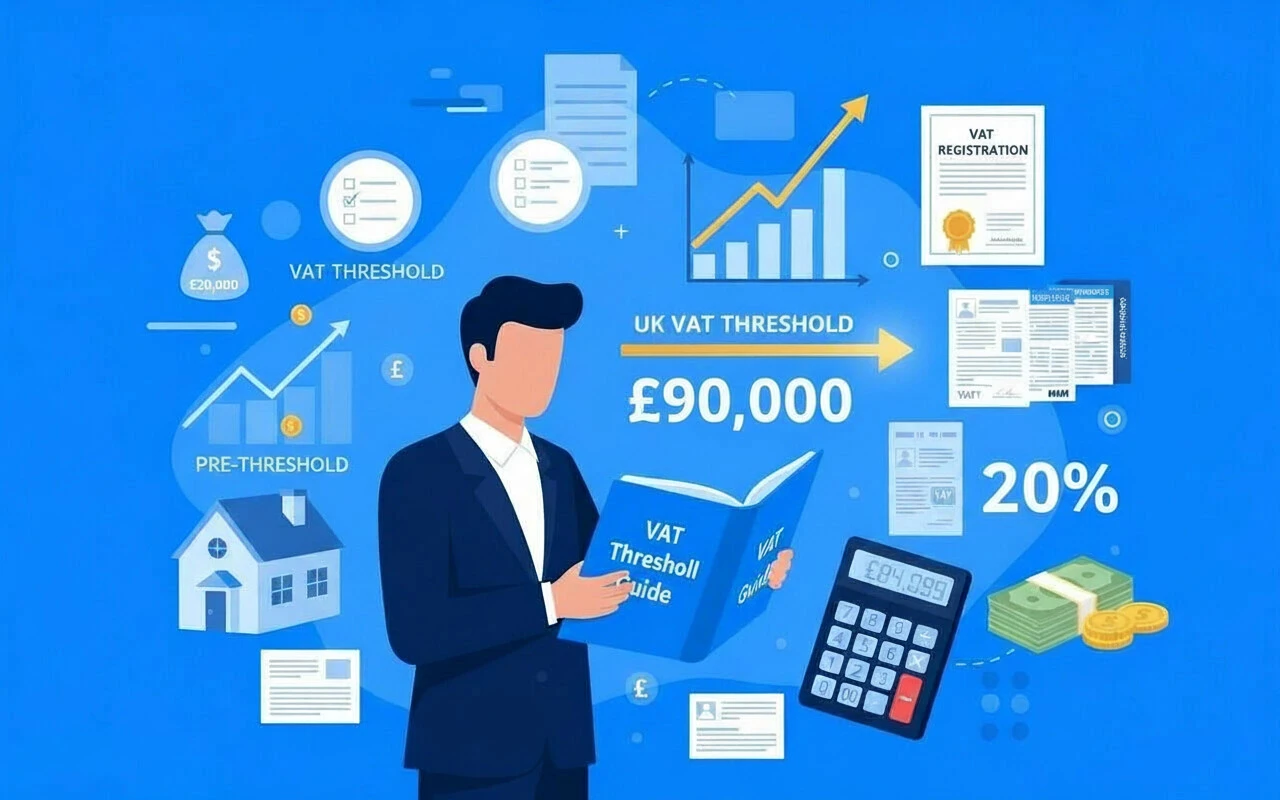
28,000 businesses were identified as potentially avoiding or missing registration by not accurately monitoring the £90,000 turnover threshold in 2024–2025. The VAT threshold applies to most UK businesses, including limited companies, sole traders, partnerships, and self-employed individuals.
In this article, we are going to clarify all of your doubts related to the UK VAT threshold so you never go under HMRC scrutiny.
What Is the VAT Threshold?
The UK VAT threshold is the point at which a business is legally required to register for Value Added Tax with HMRC. Many businesses assume VAT only applies once they become “large” or highly profitable, but VAT is not based on profit at all. It is based purely on turnover, which means businesses can be pulled into VAT much earlier than expected.
The UK VAT registration threshold is £90,000 of taxable turnover. VAT registration becomes compulsory if your turnover in any rolling 12 months period exceeds the threshold. The threshold was increased from £85,000 to £90,000 in April 2024, and has remained unchanged since. HMRC reviews the threshold periodically, so it’s worth checking the current figure rather than assuming it stays fixed indefinitely.
Why do businesses miss the VAT threshold?
One of the biggest reasons businesses miss the UK VAT threshold is because it is not measured against the tax year or calendar year. HMRC looks at your taxable turnover over the previous 12 months at the end of every month.
This rolling calculation means a business can cross the threshold at any point during the year, often without realising it has happened. By the time the issue is discovered, VAT may already be due on past sales.
What happens if you expect to go over the VAT Registration threshold?
VAT registration is not only triggered after your turnover has already exceeded £90,000. HMRC also requires businesses to register for VAT in advance if they know their taxable turnover will exceed the VAT registration threshold within the next 30 days alone. This rule is particularly important for fast-growing businesses or those that rely on large one-off contracts, as it can catch business owners by surprise.
For example, if your turnover is currently £70,000 but you sign a single contract worth £25,000 that will be invoiced within the next month, HMRC considers this enough certainty that you will exceed the VAT threshold. In this situation, you are required to register for VAT immediately, even though your historical turnover has not yet crossed £90,000. The effective date of registration is based on when you became aware that the threshold would be exceeded, not when the money is actually received.
This often affects consultants, agencies, contractors, construction businesses, and online sellers who secure large projects or seasonal spikes.
Many businesses choose to speak to Reflex Accounting at this stage, as registering at the right time can help ensure VAT is charged correctly to customers and reclaimed where possible, rather than becoming an unexpected cost later.
What happens if a business exceeds the VAT threshold?
Once the threshold is exceeded, the business must register for VAT with HMRC within 30 days. Missing this deadline can lead to penalties, even if the business was unaware it had crossed the threshold.
VAT must be charged on sales
After registration, the business must add VAT to taxable goods or services, usually at the standard rate of 20%, unless a reduced or zero rate applies.
VAT returns must be submitted
VAT-registered businesses are required to submit VAT returns, typically every quarter. These returns show how much VAT has been charged to customers and how much VAT has been paid on business expenses. Any difference must be paid to HMRC or refunded. Records must also comply with Making Tax Digital rules.
VAT on past sales may be due
If a business registers late, HMRC may require VAT to be paid on sales made after the date registration should have happened. In many cases, this VAT cannot be recovered from customers, meaning it must be paid out of the business’s own funds. This is often where VAT becomes a serious cash-flow issue.
Can You Register for VAT Below the Threshold?
Yes, businesses can voluntarily register for VAT even if their turnover is below £90,000. Voluntary VAT registration can allow businesses to reclaim VAT on expenses and may improve credibility with VAT-registered clients.
However, it also increases compliance requirements and may require price adjustments if customers cannot reclaim VAT.
How to register for VAT:
- Check if your taxable turnover exceeds £90,000 or will within the next 30 days.
- Gather business information: name, address, UTR, turnover, bank details, company registration (if applicable).
- Register online via the HMRC portal.
- Receive your VAT registration number and effective date.
- Choose a VAT accounting scheme (Flat Rate, Cash Accounting, Annual Accounting) if applicable.
- Start charging VAT on eligible sales and issue VAT invoices.
- Keep accurate VAT records and submit returns on time.
- Reclaim VAT on eligible business expenses.
VAT Rates and Exempt Items in the UK
Once you are VAT-registered, it’s important to know that not all sales are taxed the same way. VAT in the UK is applied at different rates depending on the goods or services sold, and some items are completely exempt from VAT.
Standard VAT rate (20%)
The standard VAT rate is 20% and applies to most goods and services sold in the UK. This includes items such as:
- Electronics and computers
- Household appliances
- Office supplies
- Professional services that are not exempt
When charging VAT at 20%, your customers may be able to reclaim it if they are VAT-registered themselves.
Reduced and Zero rates
Some goods and services are subject to reduced VAT rates (5%) or zero-rated (0%):
Reduced rate (5%) examples:
- Domestic energy and heating
- Certain renovations to residential properties
- Children’s car seats
Zero-rated (0%) examples:
- Most food and drink (except alcohol, confectionery, or catering services)
- Children’s clothing and shoes
- Books, newspapers, and magazines
- Public transport and certain medical supplies
Even though zero-rated items are charged at 0% VAT, they still count towards your taxable turnover for VAT threshold purposes.
Exempt items
Some goods and services are completely exempt from VAT. This means you do not charge VAT and these sales do not count towards the VAT registration threshold. Examples include:
- Financial services (insurance, lending, and bank charges)
- Education and training
- Health services (private medical treatment)
- Postage stamps and some charities’ fundraising
It’s crucial to know which items are exempt because incorrectly applying VAT can lead to penalties from HMRC.
What happens if you don’t register for VAT?
Failing to register for VAT within 30 days of exceeding the VAT threshold (£90,000) can lead to penalties, extra VAT payments, and other consequences. How much you’re penalised depends mainly on your behaviour, whether the error was genuinely accidental or deliberate and whether you told HMRC yourself or they discovered it first, not simply how many months have passed:
| Behaviour | Disclosure | Penalty range (% of potential lost revenue) |
|---|---|---|
| Non-deliberate | Unprompted, within 12 months | 0% – 30% |
| Non-deliberate | Unprompted, more than 12 months | 10% – 30% |
| Non-deliberate | Prompted, within 12 months | 10% – 30% |
| Non-deliberate | Prompted, more than 12 months | 20% – 30% |
| Deliberate | Unprompted | 20% – 70% |
| Deliberate | Prompted | 35% – 70% |
| Deliberate and concealed | Unprompted | 30% – 100% |
| Deliberate and concealed | Prompted | 50% – 100% |
HMRC may waive the penalty if you have a reasonable excuse, such as serious illness or the death of a close relative. Each case is reviewed individually, and HMRC decides whether the reason justifies a penalty reduction or cancellation.
Key Benefits of VAT registration
Registering for VAT in the UK isn’t just a legal requirement once you exceed the threshold, It also brings several practical benefits that can help your business grow, improve credibility, and reduce costs on business expenses.
- Avoids penalties and interest from HMRC for failing to register when required.
- You can recover VAT paid on business purchases and services. This can significantly reduce your costs, especially if your business makes large capital or operational purchases.
- Appears more established to clients, especially VAT-registered businesses. Many larger companies prefer suppliers who can reclaim VAT.
- Access to larger contracts and customers because some businesses only deal with VAT-registered suppliers.
- If you register voluntarily, you may be able to reclaim VAT on past purchases (typically up to four years) for assets still in use.
VAT accounting scheme thresholds
HMRC offers several VAT accounting schemes designed to make VAT simpler for businesses, but each scheme has its own turnover thresholds that determine whether you can join or must leave the scheme. These thresholds are separate from the VAT registration threshold and are based on VAT-taxable turnover, not profit. Understanding these limits is important, as using a scheme you are no longer eligible for can lead to compliance issues.
Flat Rate Scheme threshold
The Flat Rate Scheme is available to VAT-registered businesses with an expected taxable turnover of £150,000 or less, excluding VAT. Under this scheme, businesses pay a fixed percentage of their gross VAT turnover to HMRC, which can simplify record-keeping and VAT calculations.
Once a business’s taxable turnover goes above £230,000, it must leave the Flat Rate Scheme. This higher exit threshold is designed to give businesses some flexibility as they grow, but it is important to monitor turnover regularly to avoid staying in the scheme for too long.
Cash Accounting Scheme threshold
The Cash Accounting Scheme allows businesses to account for VAT based on when payments are actually received and made, rather than when invoices are issued. This can significantly help cash flow, especially for businesses that are paid late or operate on longer payment terms.
To join the Cash Accounting Scheme, taxable turnover must be £1.35 million or less. If turnover later exceeds £1.6 million, the business must leave the scheme and switch to standard VAT accounting. This scheme is commonly used by small and medium-sized businesses that want better control over VAT payments.
Annual Accounting Scheme threshold
The Annual Accounting Scheme allows businesses to submit one VAT return per year instead of quarterly returns, with advance VAT payments made throughout the year. This can reduce administrative burden and make VAT planning more predictable.
Like the Cash Accounting Scheme, businesses can join the Annual Accounting Scheme if their taxable turnover is £1.35 million or less. If turnover exceeds £1.6 million, the business must leave the scheme. This scheme is often suitable for stable businesses with consistent turnover.
Choosing the right VAT scheme
The right VAT scheme depends on factors such as turnover size, cash flow, customer payment terms, and administrative capacity. While schemes like Flat Rate can simplify VAT, they are not always the most cost-effective option as a business grows. Reviewing your VAT scheme regularly ensures compliance and can prevent unexpected VAT liabilities.
FAQs:
1. What is the current VAT registration threshold in 2026 in the UK?
The current VAT registration threshold is £90,000 in taxable turnover over any rolling 12-month period. Businesses must register once they exceed this amount or expect to within 30 days.
2. What does “rolling 12-month basis” mean for VAT registration?
It means HMRC checks your total taxable turnover over the previous 12 months at the end of each month. If this total exceeds £90,000, VAT registration is required, regardless of the tax year.
3. Can I register for VAT before hitting the £90,000 threshold?
Yes, businesses can voluntarily register for VAT even if turnover is below the threshold. This allows you to reclaim VAT on expenses and can improve credibility with clients.
4. Which types of income count toward the annual VAT threshold?
Only taxable turnover counts, including standard, reduced, and zero-rated sales. Exempt income or non-VATable items do not count toward the threshold.
5. What is VAT Deregistration Threshold?
If your taxable turnover later falls below the VAT deregistration threshold, you may be able to cancel your VAT registration. The current deregistration threshold is £88,000.
However, deregistration must be carefully planned, as VAT may still be payable on stock and assets held at the time of deregistration.
6. What happens if you go over the vat threshold without realising?
If you go over the VAT threshold without realising, you must register for VAT with HM Revenue & Customs and may have to pay VAT on sales made after you exceeded the limit.
You could also face penalties and interest, but these are often reduced if you notify HMRC promptly and correct the issue voluntarily.