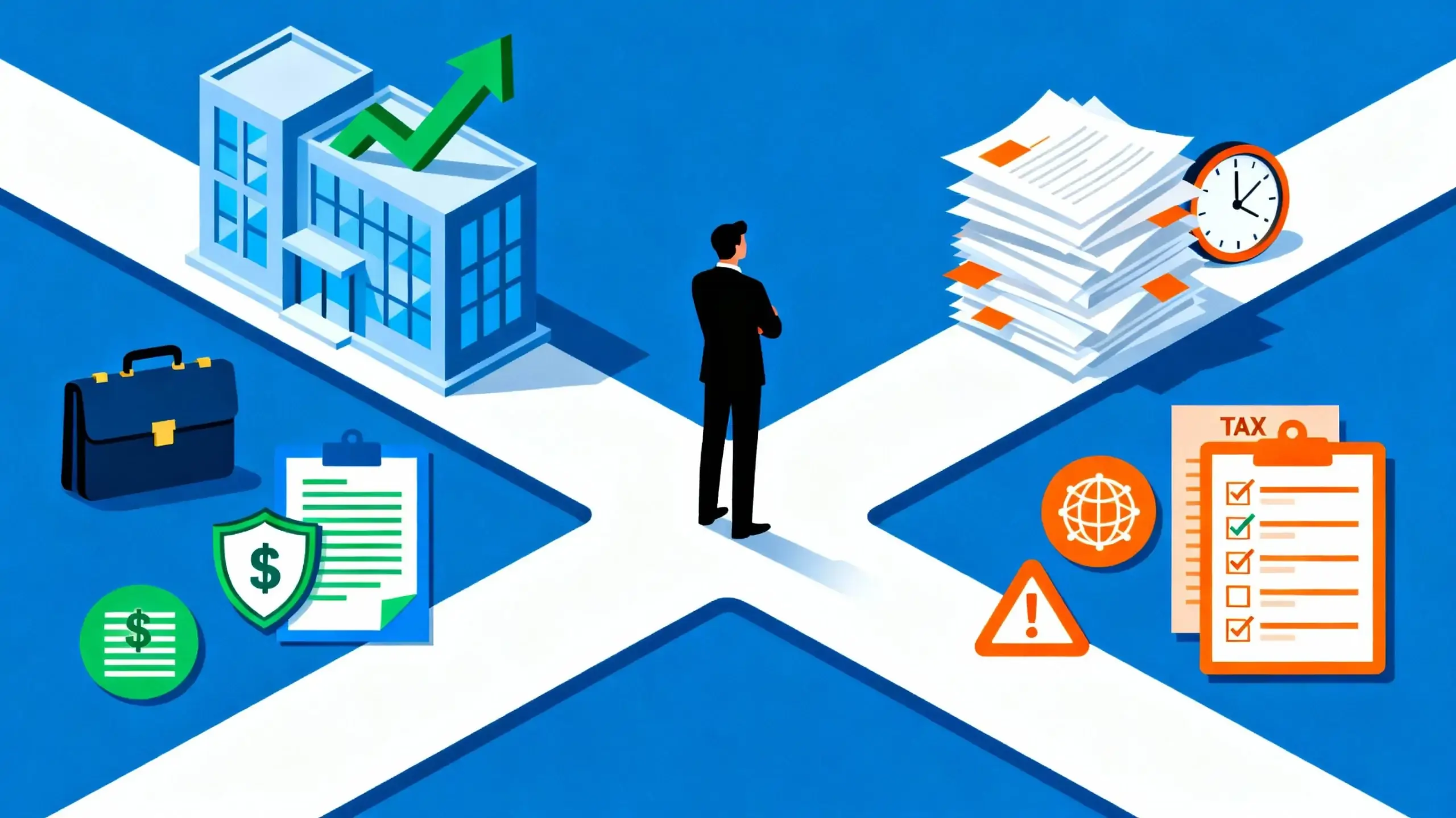
Many entrepreneurs consider the trade-offs of various models when determining how to organize their business. Establishing a private limited company is a popular choice, but is it always the best one? Among other benefits, businesses that operate as private limited companies frequently enjoy limited liability and more favorable tax treatment.
In fact, private limited companies are currently the most prevalent formal business structure, with more than 5 million limited companies registered in the UK. Over 800,000 new companies are incorporated each year according to UK government statistics.
In this article, we explore what a private limited company is, outline its key advantages and disadvantages, and guide you through formation and when to seek expert advice.
What is a Private Limited Company?
A private limited company (often suffixed “Ltd” or “Limited”) is a business entity that is legally distinct from its owners: shareholders and directors.
- It issues shares to shareholders, and those shares represent ownership of the business.
- The company’s assets, liabilities, and profits belong to the company, not to the individual shareholders.
- A private limited company is “incorporated,” meaning it is registered with the relevant authorities (for example, in the UK with Companies House), and its existence continues independently of the lives or participation of individual shareholders.
Because of this separation between individuals and the company, the private limited company structure is often chosen by entrepreneurs who want a formal, legally recognised business entity with protections for owners.
Key Advantages of a Private Limited Company
Here are some of the key advantages of forming a private limited company:
1. Limited Liability Protection
Perhaps the most significant benefit is limited liability. Shareholders’ responsibility for the company’s debts is usually limited to the amount they invested or committed to invest, shielding their personal assets (like their home or savings) from business creditors.
2. Professional Image and Credibility
The use of “Ltd” in a company name conveys credibility and professionalism. Customers, suppliers, lenders, and potential investors frequently view a private limited company as more reliable and stable than a sole trader.
This improved reputation helps you gain clients, secure contracts, and build lasting business connections.
3. Tax Efficiency
A private limited company often enjoys more favorable tax treatment compared to sole traders. Instead of being taxed at personal income tax rates, the company pays corporation tax on profits, which can be lower.
Comparison: Personal Income Tax vs Corporation Tax (UK)
| Category | Personal Income Tax (Sole Trader) | Corporation Tax (Private Limited Company) |
| Tax Applied On | Entire taxable income of the individual | Profits of the company |
| Tax Rates (2024/25) | 20% basic rate40% higher rate45% additional rate | 25% main rate(19% small profits rate may apply if profits ≤ £50,000) |
| National Insurance | Class 2 + Class 4 NICs on profits | No NIC on company profits; only on salaries |
Moreover, company directors can structure their income via a mix of salary and dividends, potentially reducing personal tax liabilities.
4. Easier Access to Capital and Growth Opportunities
If you want to attract partners or investors, private limited companies can raise money by issuing shares.
Because of its transparency, limited liability, and clearer governance, which may make it simpler to obtain loans or other funding, such a structure is typically more appealing to lenders and investors.
5. Brand Protection:
Once you register your company name, that name is reserved, helping safeguard your brand identity (No other new company can use the same name).
Also, a private limited company enjoys perpetual succession: its legal existence continues regardless of changes in ownership, retirement or death of shareholders or directors. This ensures business continuity and easier succession planning.
6. Structured Governance & Professional Management
A limited company operates under a formal governance structure, with defined roles (shareholders, directors), registered rules and compliance standards. This clarity supports better decision-making, accountability and growth planning, something that is appealing when scaling the business.
7. Retain Profits
If your goal is to keep more money inside the business rather than withdrawing everything as personal income, a Limited Company is a far stronger option than operating as a sole trader. Because limited companies are taxed more efficiently on profits that are retained. Instead of paying income tax on the full amount you earn, you only pay Corporation Tax on profits left in the business which is significantly lower than higher-rate personal tax.
Key Disadvantages of Private Limited Companies
While there are many advantages, forming a private limited company also comes with certain drawbacks.
1. Increased Administrative Burden & Regulatory Compliance
Private limited companies are subject to more formal procedures than sole trader. keeping statutory registers up to date, filing annual accounts, confirmation statements, and adhering to legal and tax deadlines.
This can take a lot of time and may call for expert assistance (such as accountants), which raises continuing operating expenses.
2. Reduced Privacy:
Following incorporation, the public can access certain information about the company, including the names of the directors, shareholders, and company accounts.
This loss of privacy can be a serious worry for some business owners, particularly if they would rather keep ownership, income, or financial information private.
3. Cost of Incorporation and Maintenance
While forming a private limited company is not prohibitively expensive, there are upfront costs (incorporation/registration fees) and ongoing costs (accounting services, compliance, filings).
For small businesses or those with low profit margins, these costs may outweigh the benefits particularly if the business remains small or informal.
4. Potential Tax or Regulatory Disadvantages
Depending on your circumstances and jurisdiction, the “tax efficiency” advantage may diminish. Smaller companies, for instance, may not benefit significantly if profits are low and extra compliance may offset the tax savings.
Moreover, the formal structure might reduce flexibility compared to a sole trader who can make quick decisions without needing to follow formal governance processes.
How to Form a Private Limited Company
If you decide that a private limited company structure is suitable for your business, here’s a simplified overview of how to form one (in jurisdictions similar to the UK; process may vary depending on country):
- Choose the company type typically “private company limited by shares.”
- Decide on directors and shareholders. At least one director and one shareholder are usually required; sometimes director and shareholder can be the same person.
- Register with the relevant authority e.g., file incorporation documents with registry (in the UK: Companies House).
- Pay incorporation fee according to recent data, standard online registration fee is £50, with incorporation often completed within 24 hours.
- After incorporation, you’ll receive a certificate of incorporation confirming the company legally exists.
- Set up company governance & compliance mechanisms e.g., maintain statutory registers, prepare and file annual accounts, confirm shareholders, appoint persons with significant control (if required), etc.
Depending on your business needs and complexity, you may also want to engage professional support (an accountant or legal adviser) to ensure compliance and efficient tax planning.
Pros and Cons of a Private Limited Company
Here is a simple table summarizing the major advantages and disadvantages:
| Advantages | Disadvantages |
| Limited liability protects personal assets | More paperwork and compliance |
| Lower corporation tax rates | Company information becomes public |
| Professional and credible business image | Higher annual running costs |
| Ability to raise capital through shares | Less flexibility compared to sole traders |
| Better access to loans and investors | Requires formal accounts and filings |
| Perpetual existence (business continues even if owners change) | Directors must meet legal responsibilities |
FAQs
Q: What are the tax advantages of a limited company?
Private limited companies often pay corporation tax on profits, which tends to be lower than the higher personal income tax rates of individuals.
Also, directors can draw income via salary and dividends, allowing more flexibility and potential tax efficiencies.
Q: What is the annual cost of running a limited company?
Besides the one-time incorporation fee, there are ongoing costs: annual confirmation statements, preparation and filing of accounts, accounting services, potentially address services, insurance, etc.
For simple small companies, accounting package fees vary widely from modest amounts to several thousands per year, depending on complexity.
Q: How long does it take to set up a private limited company?
In many jurisdictions (e.g. the UK), standard online registration can be processed within 24 hours.
Postal or paper-based registration can take longer (e.g. several days to a couple of weeks).
Conclusion
Establishing a private limited company can be a smart move for entrepreneurs seeking liability protection, tax efficiency, access to capital and a professional corporate image. However, it comes with trade-offs notably increased administrative burdens, ongoing costs, and reduced privacy.
Whether you should form a limited company depends on the scale, growth ambitions, profitability, and long-term strategy of your business. If you expect to grow, seek external funding, or build a serious brand a private limited company may offer significant advantages.
On the other hand, for small-scale operations or businesses just starting out, the additional costs and compliance might outweigh benefits.
Already have a limited company? Let Reflex Accounting handle your tax compliance and limited company accounting so you can focus on growing your business.
Book a consultation: https://reflexaccounting.co.uk/contact-us/