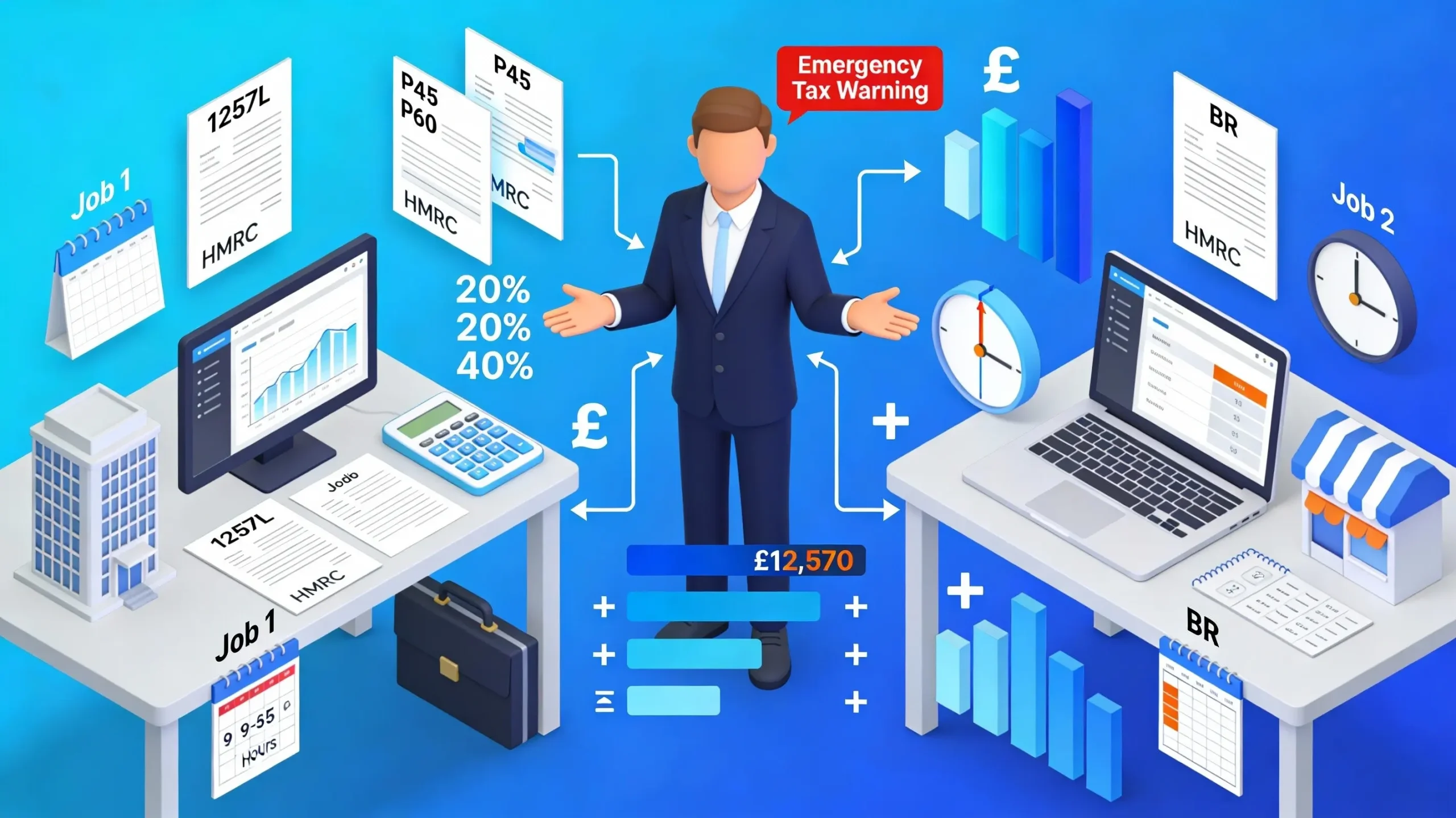
In today’s challenging economic climate, when living costs across the UK are rising, many people are turning to a second job to supplement their main income, covering the essentials while pursuing personal interests. While additional earnings can improve cash flow, people need to know how much tax they pay on a second job and if they get taxed more on a second job. According to the recent data of the Office for National Statistics (ONS), around 1.302 million people held second jobs from August to October 2025. It represents about 3.8% of those in employment. This guide helps you understand how taxes work with two jobs and what the tax rate is for the second job.
Do You Get Taxed More On A Second Job?
There is no separate or higher second job tax rate in the UK. HMRC does not tax second jobs differently in principle. Instead, income tax is calculated based on your total earnings across all employment, regardless of how many jobs you hold. For the 2025/26 tax year, you receive one Personal Allowance of £12,570 in England, Wales and Northern Ireland. This is the part of your income which is completely tax-free across everything you earn. It can only be used once and is usually allocated to your main or highest-paid role through your tax code.
How Does Tax Work with 2 Jobs?
For your second job, the employer generally uses a Basic Rate (BR) tax code for that employment. According to this code, 20% tax is applied to every pound you earn if your total income remains within the basic rate band and no separate Personal Allowance is allocated to it. The PAYE system prevents double use of the single allowance. If your combined income from both jobs exceeds the higher-rate threshold, some of your income will be taxed at 40%. It is because your overall income falls into a higher tax band.
| Tax Band | Total Taxable Income | Tax Rate on Rental Profit |
|---|---|---|
| Personal Allowance | Up to £12,570 | 0% |
| Basic Rate | £12,571 – £50,270 | 20% |
| Higher Rate | £50,271 – £125,140 | 40% |
| Additional Rate | Over £125,140 | 45% |
Examples in Practical
If you earn £30,000 from your main employment and take on a second job that earns £8,000 per year, your personal allowance will usually be used for your main salary, and 20% tax is applied to your income of £8,000.
In another example, suppose your main job pays £38,000, the second adds £20,000, and your total income reaches £58,000. After deducting the £12,570 allowance, you have to pay 20% on the next £37,700 for taxable income and 40% on the remainder. At the end of the tax year, HMRC reviews everything and adjusts for any underpayment or overpayment through a refund or a tax code change for the following year.
Understanding Second Job Tax Codes
There is a key point which is highlighted in HMRC guidance and often overlooked. It is that second jobs are not always taxed at the basic rate. Depending on your income level and HMRC’s information, your second job may be assigned to any tax code.
- A BR code means all income is taxed at 20%.
- A D0 code means income is taxed at 40%.
- A D1 code means income is taxed at 45%.
- A 0T code is used when there is no personal allowance applied, and HMRC needs more information.
These codes are administrative tools to ensure the correct amount of tax is collected throughout the year.
Can You Split Your Personal Allowance Between Jobs?
In certain situations, HMRC allows your personal allowance to be split between two jobs. This may be helpful if both jobs are relatively low-paid and neither uses the allowance on its own. If your allowance is not allocated efficiently, you may end up overpaying tax during the year and needing to claim a refund later. Adjustments can be requested directly from HMRC, or corrections may be made automatically once full income details are available.
National Insurance on a Second Job
National Insurance operates differently from income tax and is assessed separately for each employment. If you earn above the weekly threshold in both roles, you may pay National Insurance on both incomes. For employees in 2025/26, these points must be noted:
- Earnings up to £242 per week for the primary threshold are generally charged 0%
- Earnings between £242 and £967 per week are charged 8%
- Earnings above £967 per week are charged 2%.
If both jobs pay above these levels, you will need to make NI contributions from each one independently. This can result in higher overall NI than if the same total came from a single job. It’s structured this way and not viewed as double taxation in the income tax sense.
Second Income from Self-Employment
If your second job is freelance or self-employed work rather than PAYE employment, different rules apply. You may need to:
- Register as self-employed with HMRC
- Submit a Self Assessment tax return
- Pay income tax and National Insurance through Self Assessment
If your second income is from self-employment or freelance, you benefit from a £1,000 trading allowance before profits become taxable. Moreover, you report via Self-Assessment and pay Class 4 NI. According to this, you need to pay 6% on profits between £12,570 and £50,270.
Practical Steps to Manage Tax on a Second Job
- You need to complete the New Starter Checklist correctly before starting the second job. It helps your new employer to apply the right tax code.
- If combined pay from both jobs remains below £12,570, reach out to HMRC to request splitting the allowance across them for more balanced monthly deductions.
- You need to review your payslips regularly. You can use HMRC’s free online tools or tax calculators to estimate your full-year liability and find out any issues early.
- For any self-employed work, keep clear records of business expenses and file a Self Assessment tax return if your income requires it.
- If your total income falls under higher bands, contact HMRC to adjust your tax codes proactively and avoid huge end-of-year bills.
The system does not impose extra taxes simply for having multiple jobs. Instead, it taxes your overall income progressively while handling NI per job. By understanding these rules and setting things up correctly from the start, you can maximise what you take home and minimise liabilities.
Why Professional Advice Matters
Errors in tax codes are common when individuals start a second job. It gets more complicated if HMRC has not been informed or if income levels change during the year. This can result in overpaid tax or unexpected liabilities. As specialist accountants, Reflex Accounting can help clients by reviewing and correcting tax codes, estimating total pay from multiple jobs, filing Self Assessment, ensuring compliance, ensuring tax is accurate on second job and recovering overpaid tax where applicable.
FAQs:
What does the BR tax code mean on my second job?
A BR tax code means your second job income is taxed at a basicrate of 20% with no personal allowance applied. This is common where your allowance is already used by your main job. It does not mean you are being overpaid. HMRC just does not give the tax-free allowance twice.
Do I pay National Insurance on a second job?
Yes, National Insurance depends upon how much you earn and is calculated separately for each job, not on your total income. If you earn above the weekly threshold in both roles, you may pay NI in both.
Can I split my Personal Allowance between two jobs?
Yes, it can happen in some cases. If both jobs are low paid and neither uses your full personal allowance, HMRC may allow your allowance to be split between both employments to avoid overpaying tax. This can help to reduce overpaid tax during the year.
How can I check if I’m paying the right amount of tax on two jobs?
You can check by reviewing your tax codes, payslips and total income across both jobs. Comparing this information against current tax thresholds helps identify errors or overpayments. If you are unsure, ask an accountant to check whether your tax is correct and if you are due a refund.