When purchasing a second home for either investment, rental, or personal use, it is usually a sound financial investment. When you sell a second home for a capital gain, there is a very high probability that you will have a capital gains tax on the profit you made from selling your second home. The sale of your second home is subject to capital gains tax at a rate of 18% on (a) if you do not fall within the higher rate bands and (b) 24% on if you do fall within the higher rate bands, and this is assuming that the current capital gains tax rates do not change between now and the end of the 2025/26 tax years.
There are multiple strategies and reliefs you can take advantage of through HMRC to reduce or eliminate your tax liability significantly. You should never attempt to avoid local taxes through illegal means. Instead, utilise genuine relief or strategy available to you through HMRC to significantly reduce your potential tax liability or, in some cases, eliminate your tax liability.
Understanding Capital Gains Tax on Second Home
When you sell an investment property that isn’t used as your primary residence, Capital Gains Tax (CGT) applies to the profit made. The taxable amount is your net gain after deducting any allowable expenses and other deductions from your sale price.
CGT Rates on Residential Property (2025–26)
| Taxpayer Status | CGT Rate |
| Basic Rate Taxpayer (currently £37,700) | 18% |
| Higher or Additional Rate Taxpayer | 24% |
| Trusts (most cases) | 24% |
| Carried Interest (if applicable, rare for second homes) | 32% |
How the Tax Band System Works
Capital Gains Tax applies to profits from selling property (second homes) at different rates depending on two things: whether you fall above or below the basic income tax threshold and how much of your total gain belongs above or below that threshold. The portion of the gain that falls within the unused portion of the basic rate tax threshold is taxed at 18%, while the portion above that amount is taxed at 24% (higher rate). Even if you are in the higher tax bracket, you may still pay tax at the lower 18% rate on a portion of your capital gain because you may have some unused basic rates left over when compared to your total income.
How Capital Gains Tax on a Second Home Is Calculated
Chargeable Gain = Sale price – Purchase price – Allowable deductions
Allowable deductions include:
- Stamp Duty Land Tax (SDLT) paid on purchase
- Solicitor and estate agent fees (purchase and sale)
- Improvement costs (e.g., extensions, new kitchens, not repairs or maintenance)
First, subtract the annual exempt amount of £3,000 from your total profits. Then apply the above calculations to the remaining taxable profit.
For example, you bought a second home for £200,000 and sold it for £300,000, with £15,000 of allowable costs and improvements. Your total gain before exemptions is £85,000. After deducting the £3,000 annual exempt amount, your taxable gain is £82,000.
Suppose your other income for the year uses up all but £5,000 of your basic-rate band. That means £5,000 of your gain is taxed at 18%, and the remaining £77,000 is taxed at 24% (as it falls in the higher-rate band):
- £5,000 × 18% = £900
- £77,000 × 24% = £18,480
- Total CGT liability = £19,380
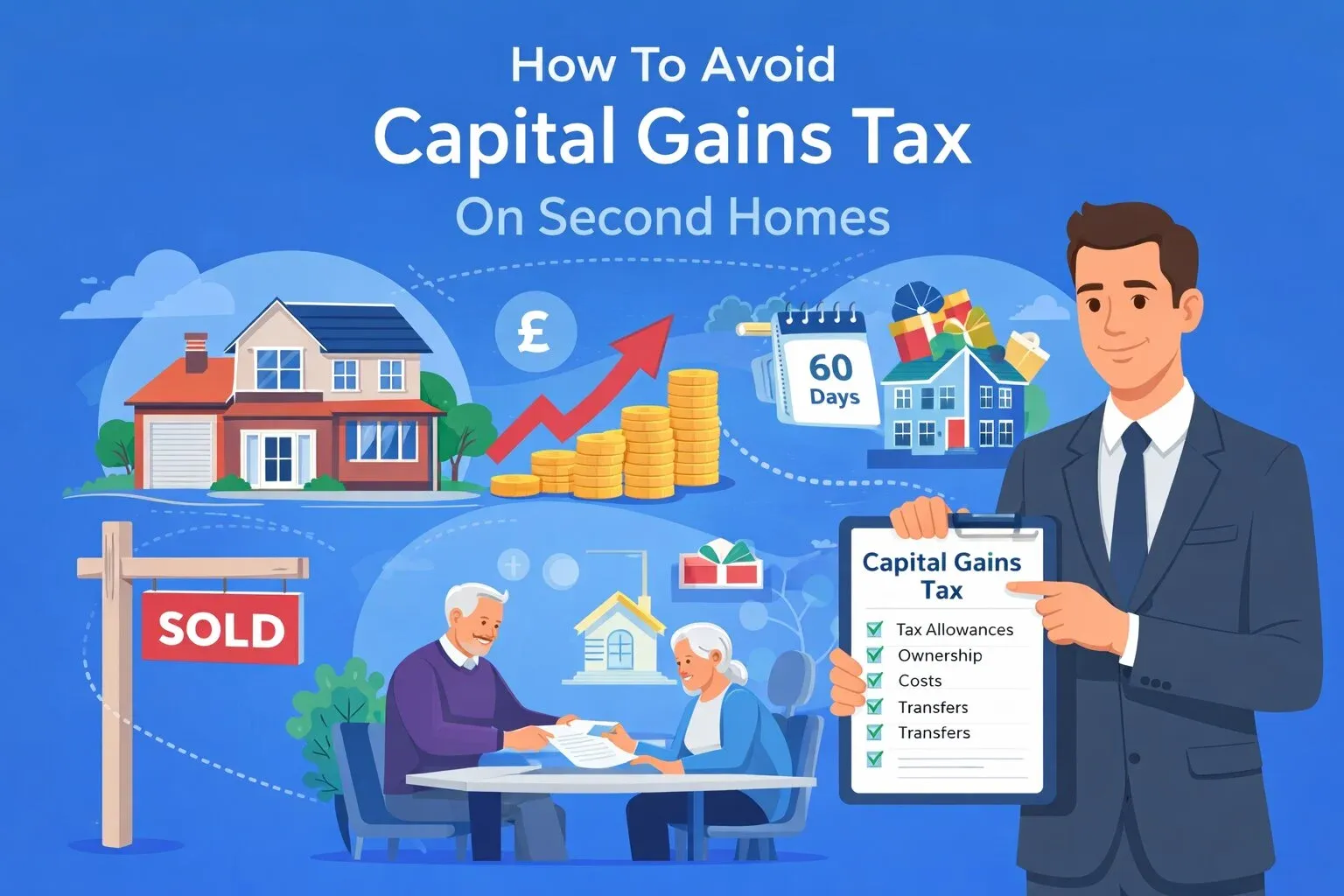
How to Avoid Capital Gains Tax on Second Homes
Although there is no definitive way to avoid taxation, the options could be very beneficial in terms of reducing your tax liability, which are given below.
1. Take advantage of Private Residence Relief (PRR)
If you have used your second home as your primary residence at one point, then you may qualify for PRR. When you sell the property, you will receive a full exemption from CGT based on the amount of time that you occupied it as your main residence. Also, you will usually receive a full exemption during the last 9 months that you owned the property. You may also be able to elect which of multiple residences you want as your main residence if you did so within a 2-year time frame from the date of acquiring your multiple homes.
2. Understand Job-Related Absence Relief
If you are absent from a property that has been your only or main residence because of qualifying employment, that absence may still count as a period of occupation for Private Residence Relief (PRR). This can reduce or eliminate Capital Gains Tax on the eventual sale of the property.
Qualifying employment-related absences include:
Working abroad: A period spent in employment where all employment duties are carried out outside the UK can qualify, with no fixed time limit.
Working away from home: Absences totalling up to four years can qualify where the distance to your workplace prevents you from living at home, or your employer requires you to live elsewhere to perform your duties effectively.
Normally, you must occupy the property as your only or main residence both before and after the absence. However, for qualifying work-related absences, you may still qualify where you cannot return because your continuing employment requires you to live away. The same rules can apply where the relevant employment is that of your spouse or civil partner.
3. Increase Your Annual Allowance
Efficient use of your allocation can decrease your tax gain.
- You can claim up to £3,000 tax-free for your allowance.
- Combine your allowance with your partner’s for a total of £6,000.
- Try to plan your disposals over different tax years if possible.
4. Transfer Ownership to Your Spouse
This is one of the most popular and successful strategies for tax planning that you can implement.
- Generally, there are no CGT implications when transferring between spouses.
- Both parties can utilise their own allocation and tax brackets.
- This could result in the total gain being taxed at a lower rate.
5. Deduct All Allowable Expenses
You only have to pay capital gains tax on the net profits from your assets. Therefore, it is important to deduct allowable costs from the gross sale price to reduce your taxable gain. Legally allowable deductions you may claim when calculating your taxable gain from an asset may include:
- The cost of purchasing the property (stamp duty, legal fees, etc.)
- Cost of improvements (extensions, renovations to property, but not maintenance)
- Cost of selling the property (estate agent fees and solicitor’s fees)
- Accurate record-keeping will help to reduce your taxable gain.
6. Time Your Sale
Your timing of selling the property will affect how much capital gains tax you pay; therefore:
- Sell in a year when you will have low income, thereby paying a lower tax rate
- Sell your property at the same time as a Private Residence Relief qualification period
- Plan for your sale so that your annual tax-year threshold is not exceeded
7. Consider Letting Relief (If Applicable)
In certain circumstances, if you rented the property after you sold it:
- You may be able to claim limited letting relief,
- which is most effective in combination with Private Residence Relief,
- with specific eligibility criteria and conditions required by current tax regulations.
Can You Avoid Paying Capital Gains Tax?
In certain cases, yes, if certain criteria are met. You can avoid paying capital gains tax if the property completely qualifies for private residence relief, the total gain is within the £3,000 annual capital gains tax allowance, and claims or deductions offset the taxable gains entirely. In most cases, the goal will be to reduce taxes rather than eliminate them from your taxable income.
Note that the annual exempt amount has reduced significantly in recent years, it was £12,300 in 2022/23, £6,000 in 2023/24, and has been £3,000 since the 2024/25 tax year, where it remains for 2025/26.
How Reflex Accounting Helps You
The complexity behind managing capital gain taxes regarding second home sales can increase considerably when you have multiple factors, such as reliefs, tax bands, and deadlines, all influencing the outcome. In situations like this, receiving proper professional guidance from Reflex Accounting and our expert property accountants can make a significant difference to your overall tax liability and ensure full compliance with HMRC regulations. We provide practical, tailored support to help you manage second home sales efficiently and minimise tax where possible.
Check our expertise below.
- We advise you on how to structure your ownership and selling of property in a tax-efficient manner to ensure that you receive the maximum benefit from reliefs and allowances.
- We assess your eligibility for principal private residence (PPR) and provide advice on nominations and timelines to help you claim your exemption.
- We provide you with an accurate calculation of your capital gains tax and handle the associated 60-day reporting requirement, thus reducing the possibility of incurring penalties.
- We provide you with advice on how to transfer property between spouses to ensure you have maximised the use of your bands and allowances.
- We will ensure all reasonable costs incurred on the purchase, improvement and sale of eligible properties are claimed in order to minimise the taxable gain.
- We will assist you in determining the best time to sell, particularly if you are considering selling a second home that was owned within the last 3 years, to reduce exposure to tax.
- We provide ongoing support by providing taxation advice related to both buy-to-let properties and long-term planning so that you can effectively manage your rental property portfolio.
Speak to Reflex Accounting today and discover how much tax you could save on your property sale. Book your free consultation now and take the first step towards smarter tax planning.
FAQs
Do you always have to pay Capital Gains Tax when selling a second home?
No, you may not pay CGT if reliefs like Private Residence Relief apply or if your gain falls within your tax-free allowance. Eligibility depends on how the property was used and how long you owned it.
Can Reflex Accounting help me legally reduce Capital Gains Tax on my second home?
Yes, Reflex Accounting’s property tax specialists review your full situation, from purchase history to future plans, to identify every relief and allowance you may be entitled to. We then build a tailored CGT minimisation strategy so you only pay what you legally have to, not more.
Can the Capital Gains Tax allowance reduce the tax on a second home?
Yes, the £3,000 annual allowance reduces your taxable gain, and couples can combine it for greater savings. This can significantly lower the final CGT liability when properly planned.
How can making a second home your main residence reduce CGT?
Living in the property allows you to claim Private Residence Relief, making part or all of the gain tax-free.
Can transferring a property to a spouse reduce Capital Gains Tax?
Yes, it allows both partners to use their allowances and tax bands, reducing the overall tax liability. This strategy is commonly used to optimize tax efficiency before a property sale.